
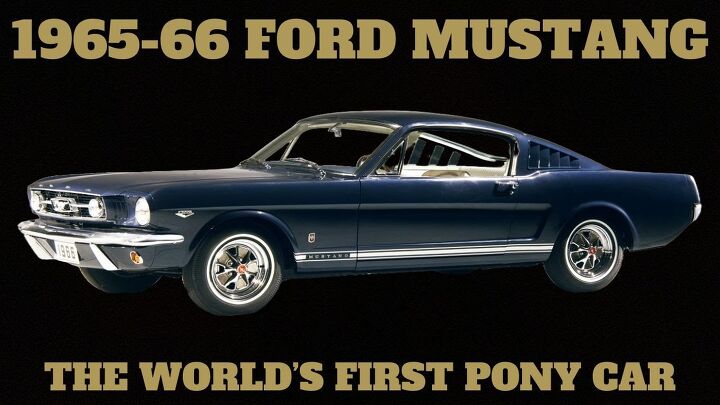
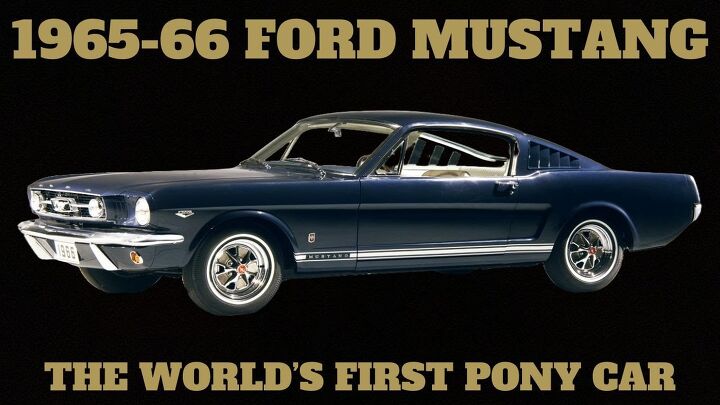
The First Ford Mustang, Lee Iacocca gets a lot of credit for bringing the Mustang to market and while it may have been his vision the person most responsible for developing that vision into an actual car was Donald Frey.
He was the head engineer for the Mustang project and he supervised the Mustangs development in a record 18 months from September 1962 to April 1964.
This video documents the first Mustang. what is was to be and how it ultimately came to market. I hope you enjoy the show.
For more Ford related content subscribe here: https://www.youtube.com/c/TonysFordsa…
The TTAC Creators Series tells stories and amplifies creators from all corners of the car world, including culture, dealerships, collections, modified builds and more.
A transcript, created by AI and edited by a staffer, is below.
[Image: Tony’s Fords and Mustangs/YouTube]
Become a TTAC insider. Get the latest news, features, TTAC takes, and everything else that gets to the truth about cars first by subscribing to our newsletter.
Transcript:
The first Mustang is often credited to Lee Iacocca for bringing the car to market. While it may have been his vision, the person responsible for turning that idea into a production vehicle was Donald Frey. Frey led the development team as head engineer, and the group managed to assemble the Mustang in just 18 months.
Three separate teams worked on three different Mustang designs, all guided by the same objectives. The car needed seating for four passengers, front bucket seats, a price under $2,500, a curb weight below 2,500 pounds, an overall length under 180 inches, and it had to be built on the Ford Falcon platform. In the end, elements from all three proposals were combined to create what became the Mustang.
Interestingly, the Mustang was nearly a four-door car and was almost named Cougar. One important note: the Shelby GT350 will not be covered here, as it deserves a dedicated video of its own. With that out of the way, this is a look at the world’s first pony car—the Ford Mustang.
Mustang. The bright new shape of total performance. The car everyone went wild for overnight. Mustang delivers all the V8 energy you can order. When you say move, it moves. You’re in charge, all the way. Sure-footed up to the high country and out to the far horizon. This is the new sports car spirit. A new breed of liveliness. The most exciting new car in a generation. A four-seater that moves away from everything else on the road. Discover all the thunder you can get at an unexpected low price. Mustang, at your Ford dealer now.
The new Mustang debuted on April 17, 1964, as a 1965 model. Its launch was one of the largest in Ford Motor Company history, held at the Ford Pavilion at the New York World’s Fair and simultaneously at dealerships across the country. The Mustang was available for immediate purchase, and nearly 22,000 were sold on the first day alone.
The car introduced the long-hood, short-deck design that would define the pony car segment. Initially, it was offered only as a hardtop or convertible. Up front, the Mustang featured an extended grille opening with a galloping horse set inside a chrome bezel, known as the corral. Dual beam headlamps flanked the grille, while a thin wraparound chrome bumper with bumper guards separated the lower valance, which housed round turn signals with chrome surrounds.
Along the sides, a reversed C-shaped body line started at the front fenders, ran through the doors, dipped down the front of the rear quarter panels, and looped back toward the door. At the rear, the taillight panel used chrome bezels to divide the lamps into three vertical segments, with a centered chrome fuel cap displaying the Mustang logo. A thin chrome bumper wrapped into the rear quarter extensions and included bumper guards, separating the taillight panel from the lower valance, which housed round backup lights.
The Mustang used a unibody derived from the Falcon platform, though with a slightly shorter wheelbase and narrower width. To increase rigidity, Ford introduced a torque box substructure, an industry first at the time.
The standard engine was a 105-horsepower, 170-cubic-inch inline six. Optional power came from a 165-horsepower, 260-cubic-inch V8 with a two-barrel carburetor. Buyers could choose either a three-speed manual or a three-speed automatic transmission.
Standard equipment included front bucket seats, a padded instrument panel, full wheel covers, full-length carpeting, a sport steering wheel with bright metal horn arms, a cigarette lighter, courtesy and glove box lighting, front armrests, seat belts, and a heater-defroster. Optional features ranged from power steering and brakes to air conditioning, a full-length console, AM radio, two-speed wipers, tinted glass, remote mirrors, vinyl roof, deluxe or wire-style wheel covers, accent paint stripes, rocker moldings, white sidewall tires, padded sun visors, power convertible tops, rear seat speakers, a compass, door-edge guards, rear seat belts, and even a spotlight.
The automotive press responded positively. Car and Driver wrote, “The Mustang rocks the automotive world by creating a new market segment for a stylish, affordable four-seat sports car.”
Mustang. Move into the cool world of Mustang. Now Ford brings you a third Mustang for 1965: the Mustang 2+2. It looks and acts like a $5,000 sports car, but costs thousands less. Available with front disc brakes, a 289 cubic-inch V8, and a special handling package. Features include functional side louvers for fresh air and a fold-down rear seat. Now there are three Mustangs for ’65.
By late August 1964—just four months after launch—Ford revised the Mustang again. The drivetrain lineup was completely updated, replacing the original engines and generator-based electrical systems. The new base engine became a 120-horsepower, 200-cubic-inch inline six. Three V8 options were offered: a 200-horsepower 289 with a two-barrel carburetor, a 225-horsepower 289 with a four-barrel, and a 271-horsepower high-performance 289. The Hi-Po engine featured higher compression, low-restriction exhaust manifolds, a dual-point distributor, an Autolite 4100 carburetor, and other performance upgrades.
A four-speed manual transmission became available for V8-equipped cars. The 2+2 fastback joined the lineup as well, offering sporty styling and a fold-down rear seat for increased cargo space. Its C-pillar louvers were functional, venting air from the cabin.
New option packages followed, including the GT Equipment Group, which added the four-barrel 289, dual exhaust with chrome tips, heavy-duty suspension, front disc brakes, grille-mounted fog lamps, a five-dial instrument cluster, GT badges, hood accent molding, and lower body striping. The Interior Group added pony seat upholstery, simulated walnut trim, a woodgrain steering wheel, courtesy lights, metal pedal trim, and upgraded door panels. Standalone options included the Rally-Pac tachometer and clock, front disc brakes, a full-width bench seat, 14-inch wheels, and low-profile tires.
Sales remained strong throughout 1965, with Ford delivering 559,451 Mustangs. Of those, 409,260 were coupes, 77,079 fastbacks, and 73,112 convertibles. A total of 15,079 were equipped with the GT package.
For 1966, Mustang returned with updated styling and performance options. A new grille, optional four-speed transmission, 289 V8 power, and front disc brakes. Inside, buyers could choose a sporty steering wheel, five-dial instrument cluster, pleated door panels, and vinyl bucket seats.
For 1966, the grille design was revised with slotted openings, and the corral was simplified. Side trim, wheel covers, and the gas cap were updated. Five-gauge instrument clusters and padded sun visors became standard. New paint and interior colors were offered, along with an AM/8-track player and AM/FM mono radio. The C4 Cruise-O-Matic automatic transmission was introduced for higher-output 289 V8s.
When Ford attempted to sell the Mustang in Germany, it encountered a naming conflict with a truck manufacturer that held the Mustang trademark. Rather than purchase the rights, Ford removed Mustang badges and sold the car as the T5 until the trademark expired in 1979.
Ford delivered 607,568 Mustangs for the 1966 model year, including 499,751 coupes, 72,119 convertibles, and 35,698 fastbacks. Of those, 25,517 were ordered with the GT Equipment Group.
The Ford Mustang has been in continuous production since April 17, 1964. Few cars can claim that kind of legacy. Many Americans either own a Mustang, have owned one, or know someone who has. What began as an affordable, sporty four-seater evolved into what many consider the pinnacle of Ford performance—even if longtime enthusiasts know the full story is more nuanced.
With the 1967 revision, the Mustang would grow slightly longer and wider, a change covered in another video. If you enjoyed this one, you’ll likely enjoy that as well. Thanks for watching. Until next time.
