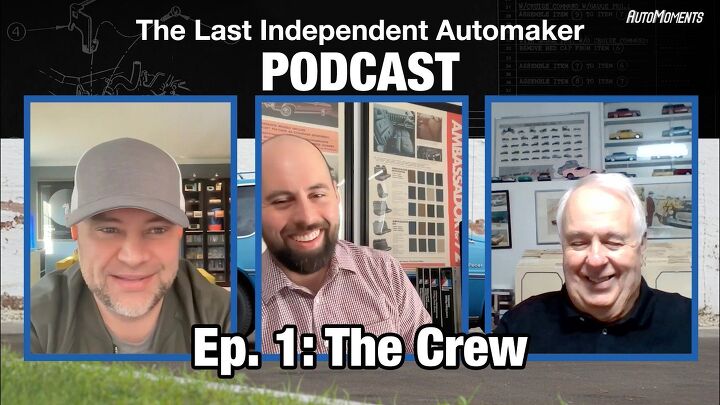
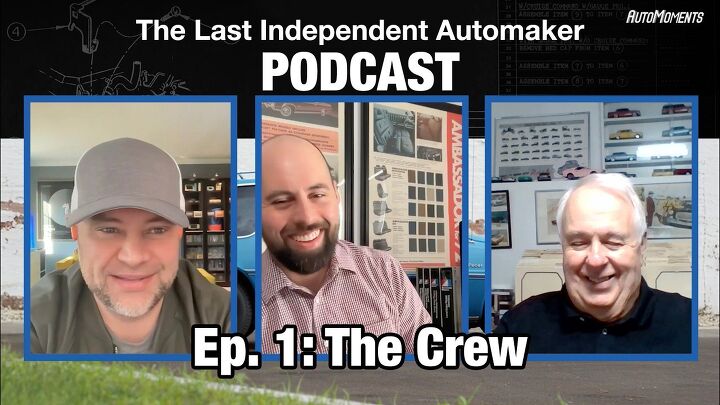
The producers are here with a behind-the-scenes podcast, telling how we made our documentary series on American Motors!
Enjoy as Joe, Jimm, and Pat explain how we met and how this project got started.
The TTAC Creators Series tells stories and amplifies creators from all corners of the car world, including culture, dealerships, collections, modified builds and more.
A transcript, cleaned up via AI and edited by a human staffer, is below.
[Image: YouTube Screenshot]
Become a TTAC insider. Get the latest news, features, TTAC takes, and everything else that gets to the truth about cars first by subscribing to our newsletter.
Transcript:
Joe Liggio:
Jim, at the time, weren’t you driving a VW Golf?
Jim Needle:
I was—and the transmission was broken. It wouldn’t go into reverse.
Joe:
Right, and the parking lot only had pull-in spots. So I had to say, “I’ve got some bad news—you’re going to have to help me push this car out after we eat.”
The Last Independent Automaker podcast is sponsored in part by Visit Detroit, the Alfred P. Sloan Foundation, Motor City’s National Heritage Area, and by the more than 375 individuals and organizations who donated to this project. Thank you.
Hello and welcome to The Last Independent Automaker Podcast. This episode kicks off a behind-the-scenes series about how we made our documentary on American Motors. I’m producer-director Joe Liggio, joined by my co-producers and good friends Patrick Foster and Jim Needle.
Patrick Foster:
Howdy.
Joe:
This is our first behind-the-scenes episode, and I thought it would be fun to go back to the very first time I met each of you.
Technically, I met Pat first—though not in person. I was in high school, before I even had a driver’s license, and I was checking out every car book I could find. There were no books on AMC. I eventually tracked one down online and asked my librarian if we could get it through interlibrary loan. They did—and I remember reading it and thinking how fascinating it was. It was a crash course in how an automaker actually works.
Pat, when did you publish that book?
Pat:
That one came out in 1992. I worked on it for a little over a year before publication, so I probably started in late 1990.
Joe:
That lines up. I was in high school then.
After that, I went to college to study video production. One of my professors said, “You should meet this alumnus named Jim.” Jim and I went to the same school, but never at the same time. Professor Brad Weaver introduced us, and we met at an Eaton Park restaurant in Cranberry, Pennsylvania.
Jim, that was when you were driving the Golf with no reverse.
Jim:
That’s right. I had to plan everywhere I parked. Most places I’d look for a drive-through spot. But Eaton Park only had pull-in parking, so I warned you ahead of time that I’d need help pushing the car out.
Joe:
Jim later became an advisor on my senior project, a documentary on the AMC Pacer. That project is also where I met Pat in person for the first time—at the 2013 AMC show.
I remember walking around with a friend, trying to interview people, having no idea what I was doing. Then I saw a tent that said “Meet Pat Foster.” I realized you were the Pat Foster—the guy who wrote the book. I interviewed you, and you said, “If you’re interviewing me, you need to meet Vince Geraci.” That opened the door to so many connections.
That Pacer documentary ended up jump-starting my career in television and video.
Pat, what did you think when you met me back then?
Pat:
Honestly, I was a little wary. I’ve been approached by a lot of people over the years with big ideas that never went anywhere. But you seemed sincere. Vince and I talked about you afterward, and we both thought, “This guy actually might follow through.”
And you did.
Joe:
In 2015, I was reading Pat’s second book before it came out. I remember thinking, “I did a documentary on the Pacer—what if we did one on all of AMC?” I didn’t know the costs, the technical requirements, or how big the project would be. I texted Jim and asked if he wanted to do it together.
Jim said yes.
Then I emailed Pat and drove up to Connecticut to pitch the idea in person. That took some convincing, understandably.
Pat:
I’d had a bad experience with a filmmaker who gathered contacts and never followed through. But again, you showed sincerity—and stamina. People underestimate how important stamina is for a project like this.
Joe:
Pat, your connection to AMC goes way back. Can you give us the short version of how you went from salesman to historian?
Pat:
It started earlier than sales. I worked for Saab in the U.S., but I loved the AMC Gremlin. I had photos of Gremlins all over my desk. After Saab ran into trouble, I went into sales and eventually became an AMC salesman.
I started writing to AMC—Dick Teague, public relations—asking questions, buying literature. John Conde from AMC PR sold literature on the side, and I bought thousands of dollars’ worth. That’s where my archive began.
Those contacts led me to write magazine articles. One editor told me, “There’s no book on AMC—people like you are the source.” I said I wished someone would write one. He replied, “We’re all waiting for you to do it.”
That stuck. I started my first book the next day.
Joe:
Your archive played a huge role in the documentary—tens of thousands of photos.
Pat:
That archive grew because people trusted me. I met George Romney, Dick Teague, Ed Anderson, Bill Reddig—people from Nash and AMC styling. Bill Reddig became a close friend. The stories he told were incredible.
AMC really was a family. I started attending employee Christmas parties in the ’80s. Vince Geraci would bring me along, introduce me to people, make sure I was fed. That sense of community never went away.
Joe:
Jim, you weren’t a car person going into this. What drew you in?
Jim:
You said something that stuck with me: if we didn’t capture these stories now, nobody else would. That alone hooked me.
And it turned out to be true. Over the ten years we worked on this, several people we interviewed passed away. Some families later asked us for copies of interviews so their kids could hear their parents’ voices again. That made everything worth it.
Joe:
Before we wrap up, we have to mention the napkin contract.
Jim:
Cheddar’s Scratch Kitchen.
Joe:
We signed our first “business agreement” on a napkin there in 2017. I still have it.
Joe:
This project wouldn’t exist without help from so many people—interns, friends, archivists, historians, donors, sponsors, and especially our families. My wife Laura carried this project just as much as I did.
Jim:
And your brother Rich deserves credit too. Watching how you leaned on him reminded me of my relationship with my own brother.
I also want to thank Adam, our motion graphics designer. Once Adam touched the project, it looked professional.
Pat:
Thank goodness we did this when we did. We preserved stories that would otherwise be lost. That’s what historians do.
Joe:
This is just the first episode of The Last Independent Automaker Podcast. We’ll be talking with narrators, archivists, car owners, and many others who helped make this project possible.
Thanks for listening—and if you haven’t already, all six episodes of The Last Independent Automaker are available on YouTube and the PBS app.
