
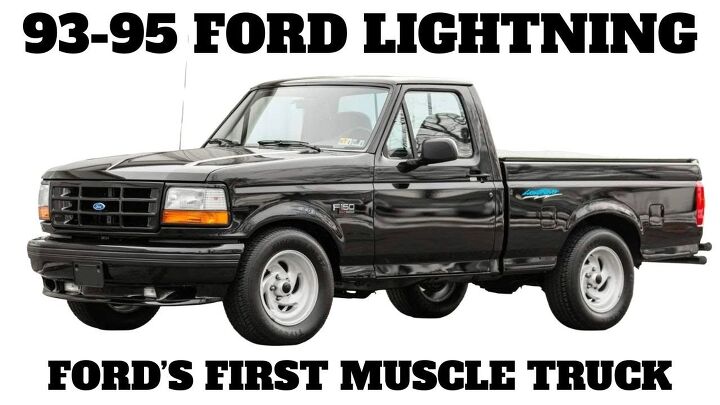

The first generation SVT Lightning. It was built by hot rodders for hot rodders.
The full size pickup truck evolved from a work only vehicle into a daily driver for many Americans. Ford had positioned itself at the forefront of this market trend by adding trim levels with many options and creature comforts to their F-Series lineup but they had never tried to market a factory performance version of The F-series. This would be their first attempt.
For more Ford related content subscribe here: https://www.youtube.com/c/TonysFordsa…
The TTAC Creators Series tells stories and amplifies creators from all corners of the car world, including culture, dealerships, collections, modified builds and more.
A transcript, created by AI and edited by a staffer, is below.
[Image: Tony’s Fords and Mustangs/YouTube]
Become a TTAC insider. Get the latest news, features, TTAC takes, and everything else that gets to the truth about cars first by subscribing to our newsletter.
Transcript:
The first-generation SVT Lightning was a truck built by hot rodders, for hot rodders.
Before diving in, a bit of background helps set the stage. In the late 1960s and early 1970s, a shift began in the pickup truck market. Trucks were increasingly being used as daily drivers rather than strictly work vehicles. Ford was at the forefront of this trend, adding options, creature comforts, and trim packages that made their pickups more comfortable places to spend time.
What Ford hadn’t done, however, was market a true performance version of its full-size pickup. That idea wasn’t entirely new. Dodge had introduced the Lil’ Red Express in the late 1970s, but while it looked the part—with bold graphics, wheels, and vertical exhaust stacks—it didn’t offer meaningful performance gains over a standard pickup. Chevrolet followed in 1990 with the SS454, a truck designed primarily for straight-line speed, not handling.
When Ford decided to enter the performance truck space, the approach was different. The truck needed to look the part, go quick in a straight line, and handle significantly better than the average pickup. That brings us to the vehicle at hand: the first-generation SVT Lightning.
Launched on December 15, 1992, as a 1993 model, the Ford Lightning was often described as a Mustang GT with a bed. It featured a monochromatic paint scheme and was available only in Bright Red Clearcoat or Black Clearcoat. The front end wore a spoiler with integrated driving lights, while the sides featured Lightning decals.
The truck rode on 17×8-inch cast aluminum, argent-painted teardrop five-spoke wheels wrapped in P275/60HR17 Firestone Firehawk GTA tires.
Power came from Ford’s 351-cubic-inch (5.8-liter) multi-port fuel-injected V8, but SVT made several key changes. It received high-flow GT40 Motorsport cylinder heads, a higher-lift Motorsport camshaft, a larger 65 mm throttle body, and a tuned two-piece aluminum intake drawing air through a low-restriction filter. Tubular stainless steel headers were added on the exhaust side. The result was 240 horsepower and 340 lb-ft of torque.
The only available transmission was Ford’s E4OD automatic, which was electronically recalibrated for quicker shifts and better use of the engine’s torque. An aluminum driveshaft was used, along with a heavy-duty 8.8-inch limited-slip rear differential with 4.10 gearing.
Car and Driver tested a 1993 Lightning and recorded a 0–60 mph time of 7.2 seconds. The truck ran the quarter mile in 15.8 seconds at 86 mph, with a top speed electronically limited to 110 mph.
The Lightning wasn’t just about straight-line performance. SVT focused heavily on handling as well. The truck used thicker frame rails borrowed from the F-250 4×4 to improve rigidity, along with additional gusseting at high-stress points. Specially calibrated Monroe Formula GP shocks were fitted, along with unique springs that lowered the front by one inch and the rear by 2.5 inches.
Thicker one-inch front and rear stabilizer bars were added, and the steering ratio was tightened to 17:1 lock-to-lock. For braking, Ford used larger 11.72-inch front discs and rear anti-lock drum brakes.
Inside, the Lightning received several driver-focused upgrades. It featured full instrumentation, including a tachometer, premium bucket seats with side bolsters, and power lumbar support. The interior was available only in Opal Gray.
Standard equipment included XLT trim, an AM/FM cassette stereo with four speakers, power windows and locks, air conditioning, cruise control, tilt steering wheel, and interval wipers. Optional equipment included a tubular rear bumper, power side mirrors, a trailer towing package, a sliding rear window, and a CD player.
The automotive press responded positively, with more than 150 favorable articles published shortly after launch. Buyers agreed, but Ford limited production. Only 5,276 Lightnings were built for the 1993 model year.
For 1994, changes were minimal. A new steering wheel with a standard driver-side airbag was added, along with a center console that could convert into a third seat. Ford also introduced a third exterior color: Oxford White. A total of 4,007 Lightnings were delivered for the 1994 model year.
The 1995 model year marked the end of the first-generation Lightning. No significant changes were made, and Ford delivered 2,280 trucks that year. Over its three-year run, a total of 11,563 first-generation SVT Lightnings were built.
This version of the Lightning was essentially SVT showing what could be done on a limited budget. According to Car and Driver, the truck achieved 0.88 g on the skidpad. While that may not sound impressive by modern standards, it’s worth remembering this was a 4,500-pound truck in the early 1990s.
When new, the Lightning cost about $2,000 more than a Mustang Cobra. While many buyers might have preferred the Cobra, it also came with significantly higher insurance premiums. The Lightning avoided that issue and still offered full towing and hauling capability, rated the same as a standard F-150—something the Mustang couldn’t match.
For collectors today, first-generation Lightnings remain relatively affordable. In today’s market, they typically cost about a third of what a 1993 SVT Cobra commands, with prices generally landing in the mid- to high-$20,000 range, and more for exceptional examples.
After production ended, the Lightning nameplate went dormant for several years before returning in 1999—this time with a supercharger. That truck is covered in another video.
If you enjoyed this one, consider liking the video and subscribing to the channel, which features over 250 videos covering Ford, Lincoln, and Mercury products.
Thanks for watching, and we’ll see you next time.
