
Last week, President Donald Trump rescinded the endangerment finding. This, quite frankly, is a breathtakingly stupid move from a president that has done plenty of breathtakingly stupid things during his two terms in office.
I try to be fair in these op-eds — fair to those who I disagree with. It’s the intellectually honest thing to do. But sometimes the truth is too harsh for fairness. And the truth is that what Trump has done will make a few rich folks richer while risking the health of the rest of us. I’m seeing a level of red that matches the stop sign at the end of my block.
Not because I am left-of-center politically (I am on most issues, though not all). Or because I don’t like our current president and his actions/policies (for the most part, I don’t — and not because of partisan reasons, but because much of what he’s done in term two is objectively bad. Not to mention often unconstitutional and perhaps illegal).
No, I am mad because I like to breathe easy. And Trump is undoing decades of bipartisan work that was meant to help us do exactly that.
Let’s back up. Here’s what the endangerment finding is, according to The New York Times, “a 2009 scientific conclusion that greenhouse gas emissions pose a danger to Americans’ health and welfare. The finding was based on more than 200 pages of research and evidence.”
The Environmental Protection Agency has used this finding to, again from the Times: “justify regulations that limit carbon dioxide, methane and other pollution from oil and gas wells, tailpipes, smokestacks and other sources that burn fossil fuels.”
Before you accuse me of partisan hackery, keep in mind that it was a Republican president, Richard Nixon, who created the EPA, and it was the first President Bush that signed an international treaty regarding controlling climate change.
Indeed, pre-Trump, greenhouse-gas pollution was generally considered bad by the political left and right.
Which makes sense, because a poisoned atmosphere doesn’t give a flying fiddlestick who you vote for.
Now, according to the advocacy group the Environmental Defense Fund, we’re at risk of having greenhouse gasses increase by 10 percent over the next 30 years. All because either Donald Trump A) doesn’t understand that the science on greenhouse gas has been settled and we know it’s harmful, B) he understands and doesn’t care, C) wants to lower costs for corporate donors from Big Oil, or D) some combination thereof.
Oh, and here’s a nice little rub — this change will be difficult for a future administration to reverse. It can’t simply be brought back by a more environmentally friendly admin.
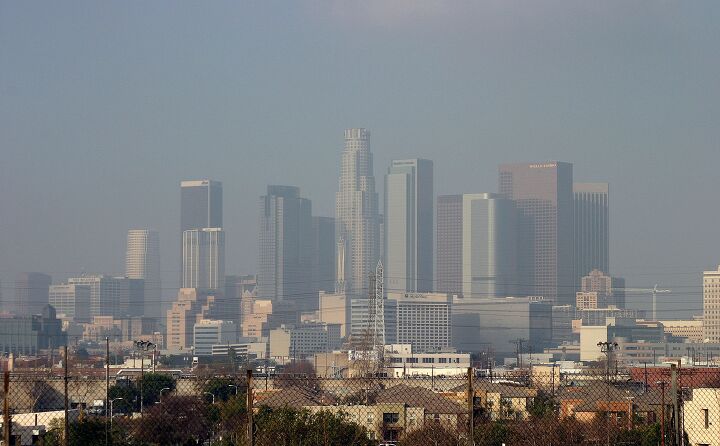
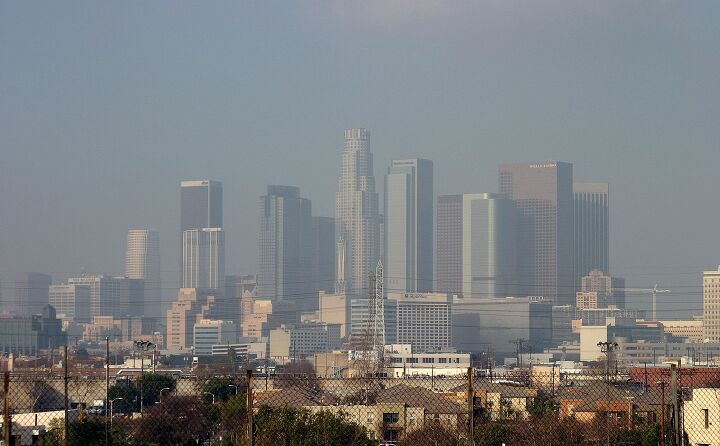
Maybe our younger readers don’t remember the pictures of downtown Los Angeles choked in smog, but I do. I fly to L.A. this week, and I’ve been there often over the past 15 years. It’s been nice seeing clean air over DTLA. Fun while it lasted.*
*To be fair, smog still envelopes LA at times. The picture at the top was taken just last year.
What angers me is that this is so unnecessary. We’ve known greenhouse-gas pollution is bad for the climate — and, of course, humanity — for decades. Longer than I’ve been alive, I believe. Earth Day isn’t exactly new. Yet, we’re intentionally, knowingly making health outcomes worse for society for no good reason.
It would be like taking a vaccine that we know works and has nearly eradicated a deadly virus and stopping its use based on faulty science and/or because some contrarians can make some money off of misinforming the public. Oh, wait.
I suppose I do have one bias — I have mild sinus issues. Nothing unusual, I don’t even need an inhaler, but I do take over-the-counter medication. I have had surgery to try to breathe better. I’m sensitive to the atmospheric conditions at times. So, yeah, I want to breathe easier. Sorry for taking a side.
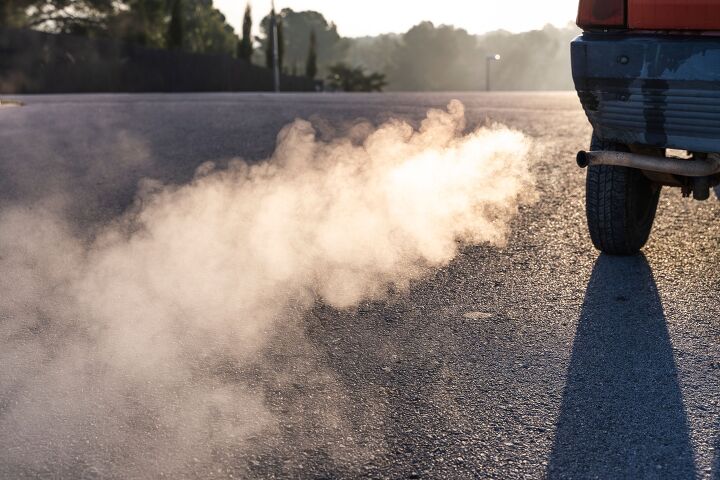
You may be asking what this has to do with cars. Well, according to the Trump administration, auto manufacturers would be part of a group of industries saving $1 trillion. But as per usual with this truth-challenged and reality-deficient administration, Trump’s folks provided no evidence to support that claim.
Furthermore, this move essentially means that the U.S. no longer has emissions standards.
That’s not my claim — just ask the experts. Also from the NYT:
“The U.S. no longer has emission standards of any meaning,” said Margo T. Oge, who served as the E.P.A.’s top vehicle emissions regulator under three presidents and has since advised both automakers and environmental groups.
Think about that. This country, one that once led the world, or at least tried to, when it came to reducing pollution, now essentially has fewer standards than countries that we once castigated for polluting too much.
The transportation sector, of course, is the largest source of greenhouse gases in the States. That includes personal cars.
To be clear, some standards do remain. The Department of Transportation is still going to regulate fuel economy, and some of the more harmful tailpipe emissions, like nitrogen oxides, will still be regulated by the EPA. Although the administration is also working on weakening the restrictions on harmful emissions.
But here’s one problem — the state of California, with its massive population and traffic-clogged cities, is sure to sue. Which will make product planning a headache for automakers.
Another problem — as the TImes reminds us, the Trump administration is working to, in essence, leave the auto industry almost unregulated. From the Grey Lady, yet again:
But last year, the Trump administration proposed weakening the fuel economy standards to largely irrelevant levels. The Republican-controlled Congress also set civil penalties for violations at $0, essentially making them voluntary for automakers. In addition, Congress last year blocked California’s clean-car rules.
So, in the end, the U.S. will be different from most of the rest of the industrialized world, since those countries will still have rules about fuel economy and/or tailpipe emissions.
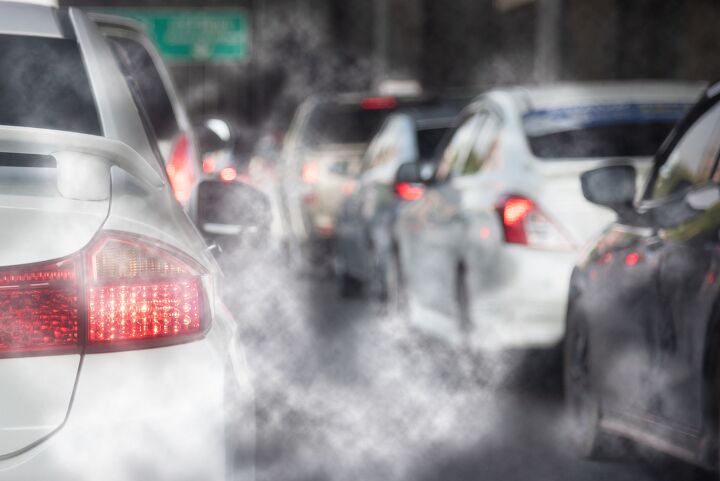
But won’t fewer regulations reduce the cost of cars, you ask? Well, maybe. But it’s not like emissions regulations are new. The auto industry already went through the malaise of the ’70s, when emissions equipment like catalytic converters were required to be added to vehicles, and it has come out the other side with cleaner, more fuel-efficient internal-combustion engines that make more power. Today’s sports cars could blow the doors off anything from the ’70s and still pass an emissions test, although some do run through fuel at a prodigious rate.
Forget about sports cars, though — today’s commuter cars are generally more powerful than before and more fuel-efficient.
So the auto industry didn’t need this. It’s already figured out how to build cleaner cars without sacrificing power. And it’s not likely that we’ll see emissions equipment disappear.
OK, you say, well, maybe consumers will still choose more fuel-efficient cars over gas-guzzling trucks? Well, maybe, but trucks were already hot sellers under tighter rules. So that remains to be seen.
What’s really odd about this is that Trump is making these changes right as China threatens to enter our market with electric vehicles — EVs that by all accounts are better than what’s currently being produced by the American, Japanese, Korean, and European makes.
I will note here that China isn’t the only threat — the European, Japanese, and Korean makes are also working on pushing the industry towards EVs. As are regulations in other parts of the world.
Yes, American automakers, along with foreign makes that sell in the States, have been struggling to increase EV sales and adoption. That’s because, as we’ve discussed ad nauseum in these pages, there are infrastructure challenges such as reliably finding working fast chargers. But at some point, EV adoption was, if not still is, likely to accelerate. Especially since very smart people are working to solve those problems — and perhaps make a buck while doing so.
So, to sum up, the Trump administration has moved backwards on greenhouse gases while the rest of the world is working to mitigate the threat of climate change by working to increase EV adoption. And he’s doing so while China and the rest of the world is threatening, in part via the sales of high-quality EVs at affordable prices, to dominate the automotive market.
It’s almost as if he doesn’t care about the nuances of a complex industry and would rather takes us back to the 1960s because he’s stuck in the past, or because he wants to please certain donors, or because he can’t be bothered to learn about how the real world works. Probably some combination thereof.
To be fair, some of the naysaying is a bit far-fetched. Oge, the expert quoted by the Times, doesn’t believe American automakers will survive the challenges from China after these changes. I am not THAT pessimistic. Still, experts worry, according to the Times.
Any resulting shift by American automakers toward gas guzzlers that can’t be sold in Europe or China could further isolate the U.S. market. And the United States would increasingly cede the future of automotive technology to Chinese electric vehicle giants like BYD, experts said.
“We’re an outlier now,” said Joshua Linn, a professor at the University of Maryland who studies environmental policies and the transportation sector. “Those larger trucks and S.U.V.s tend to make them more money,” he said. “But if they want to compete in Europe or East Asia, they really need to be able to produce these E.V.s.”
We also already mentioned that California will likely sue. About 13 other states model their standards after California, and will likely sue, too. Imagine being a product planner trying to design cars for a divided market.
Analysts do think that automakers will be smart enough not to totally retrench on EVs. Not just because of potential competition from overseas, or the desire to sell EVs in markets with more stringent rules, but because automakers would also want to hedge. So, perhaps, we’d see more ICE models and some pullback on EVs, but not a full abandonment of electrics.
On the other hand, car companies might prioritize short-term profits. That could mean a focus on gas-guzzling trucks at the expense of EV efforts. Do we not remember the short-sighted business strategies during the lead up to the bailouts? When American OEMs conceded the small- and midsize-sedan segments to Asian competitors in favor of more profitable trucks and then found themselves bent over a barrel when gas prices spiked right as the global finance system collapsed? Maybe American automotive CEOs could’ve avoided going to Washington, hat-in-hand, if their small cars stole away some buyers from Honda and Toyota?
But I digress.
Look, we can argue about how stringent emissions and fuel-economy rules should be. I personally thought the Biden administration’s goals, while well intentioned, may have been asking for too much too soon, especially given the state of tech as it stands today. Then again, it can be hard to tell from the outside if the tech truly isn’t ready to help automakers meet stricter standards, or if car companies are crying foul unnecessarily in order to keep costs down.
But what we can’t argue about is this — greenhouse gases are bad for the climate and bad for humans. This is science that is as settled as possibly can be. Moving backwards may or may not be bad for the automotive industry, but it’s going to be bad for us.
[Images: mikeledray/Shutterstock.com, Deliris/Shutterstock.com, khunkornStudio/Shutterstock.com]
Become a TTAC insider. Get the latest news, features, TTAC takes, and everything else that gets to the truth about cars first by subscribing to our newsletter.
