
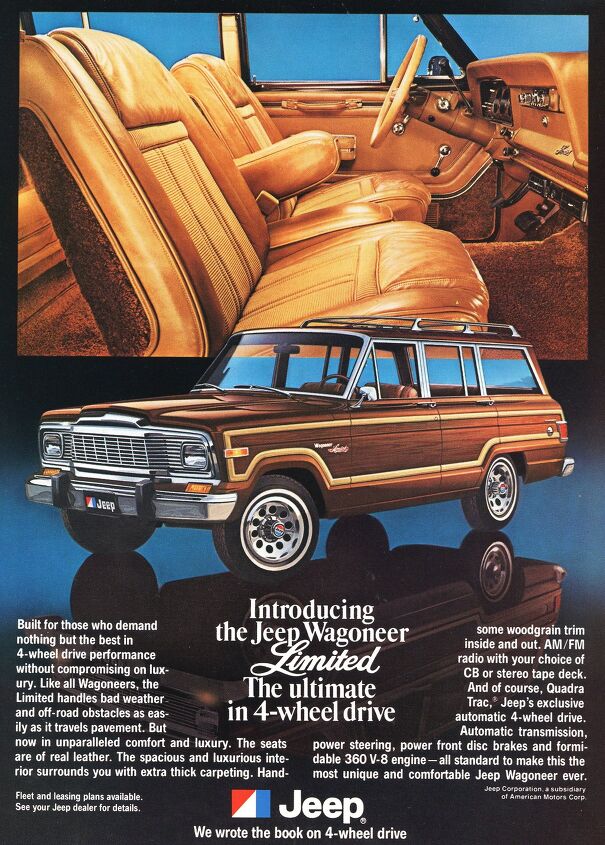

After their purchase of Jeep in 1970, American Motors began diversification of the newly acquired brand’s product line. The company saw the potential in Jeep for a much broader offering of passenger utility vehicles: Utility wagons, recreational utility vehicles, and trucks. The former two would gradually converge together in nomenclature to be called SUVs, a term Jeep created in 1974 when it marketed the new Cherokee (an SJ Wagoneer derivative). Part of the product diversification was refinement of the Wagoneer platform and experimentation with luxury trims after the Super Wagoneer failed to see much success. In 1978 AMC launched a new luxurious Wagoneer trim, and this time it worked.

The utility wagon market was changing in the late Seventies, as consumers proved they were willing to pay more for wagons (and pickups) with equipment far beyond the basic rigs of the past. General Motors launched the hugely successful C/K Suburban in 1973, which remained in production through 1991 just like the Wagoneer. With a more user-friendly design, the Suburban also (finally) had four passenger doors.
And like the Wagoneer, GM would refine and trim and introduce luxuries to the Suburban (both Chevrolet and GMC used the same model name) through the years. By the late Seventies, the large utility wagon market was served only by GM and Jeep, as International cancelled its final Travelall in 1975. IH was unable to sustain its model offerings during the OPEC Crisis, when its engines were dated and notably less efficient than the competition.

The first sustained upmarket push for the Wagoneer was a 1978.5 trim addition, the Wagoneer Limited. Limited began as a step above the already plush Super Wagoneer of a few years prior. With power disc brakes all around, standard air conditioning, power locks, windows, and seats, and standard leather upholstery. It also had a leather-clad tilt wheel, cruise control, more plush carpeting than other models, radio with AM/FM and CB, a roof rack, and forged aluminum mag wheels with whitewalls. Limited models were identifiable via their much thicker exterior wood paneling.

Most every option of the regular and Custom Wagoneers was standard on the Limited. All Wagoneers used a two-barrel 360 (5.9L) V8 by this time, where the AMC I6 was relegated to the standard engine of the Cherokee. Optional even on the limited was the high-power four-barrel 401 (6.6L) AMC V8.
Luxury credentials for the Wagoneer Limited were proved via its application of such a heavy standard feature set, standard V8, and power everything. If that wasn’t enough, there was the Wagoneer Limited’s asking price. In 1978 it asked $10,500 ($54,900 adj.). For reference, in 1978 a Lincoln Continental topped out at $10,165 ($53,148 adj.), Cadillac DeVille asked $10,445 ($54,612 adj.) and an Eldorado was $11,920 ($62,324 adj.).

Immediately an exclusive vehicle, the Wagoneer Limited boosted the model’s overall sales. In 1979 there was a styling update, making the Limited trim a half-year offering in the Wagoneer’s old style. The update put the “modern” front end on the Wagoneer, and added a vertical slat grille in chrome, doing away with the eggcrate permanently. Worth noting, the same front end treatment was given to all SJ models, including Cherokee and pickups.

The circular sealed beam lamps were changed for the first time, and became square. Their housings were square to match. The grille took up a larger portion of the front end, as the hood was pulled back slightly, and the power bulge at the terminus made a part of the grille rather than the hood. It created a blunt looking front end, and enhanced attention to the power bulge.

Returning for duty were amber indicator lenses above the bumper. Those vanished circa 1973 with an update to the grille that saw large circular indicators set into it. Just beneath them, a revised bumper debuted with vertical bumper guards and black trim rub strips.

The rear bumper was revised as well, and got more square, losing its curved inset detailing. Though the rear lamp design remained the same, the trim panel at either side of the license plate was edited, and became vertical square blocks to mimic the shape of the indicator lenses at the rear. The design previously wore a horizontal bar design to mimic the grille.

Interior updates also arrived with the 1979 refresh, and included more wood trim on the interior in various places like the dash and door panels. Notably upgraded were the door panels of upper trims, which received thicker padding and nicer materials, a lesser variant of what was found in the 1978.5 onward Limited. Arm rests were upgraded with additional trim, and a new door pull appeared in a luggage strap style under the window (like a luxury sedan).

Thicker carpets appeared at the lower door panel, and there were now several different textures of materials on the door, not just one. A greater portion of the door was upholstered on the inside, where in 1978 there was a much larger volume of painted metal visible to the occupants. In other places on the interior, a variety of new upholstery options were offered in plaid fabric, soft vinyl, and leather in the instance of the Limited.

The greater economy and subsequent changes to fuel prices caused the awakening of the American consumer to the importance of fuel economy at the close of the Seventies. That would force AMC to reconfigure its largest utility wagon. AMC would also create what was the first crossover SUV in 1980, though they didn’t realize it at the time.
Shortly thereafter, AMC began its efforts to replace and subsequently terminate the dated SJ Wagoneer. Each and every time consumers thwarted such ideas, clinging to the ancient SJ. We’ll pick up in the early Eighties in our next installment.
[Images: Jeep, seller]
Become a TTAC insider. Get the latest news, features, TTAC takes, and everything else that gets to the truth about cars first by subscribing to our newsletter.