
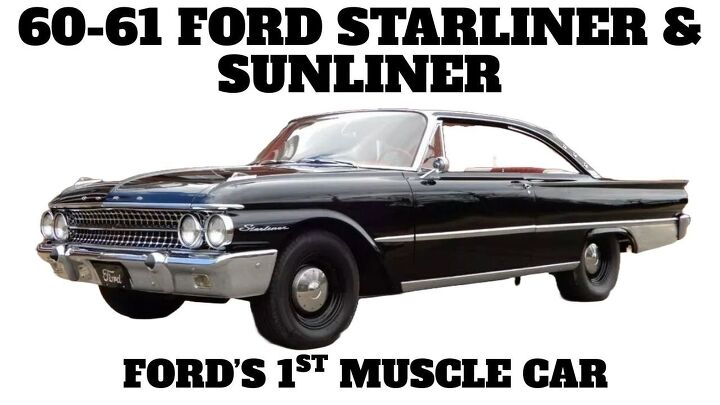
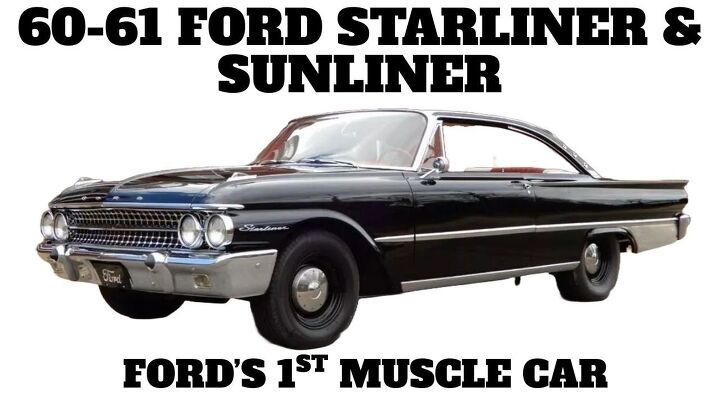
The Ford Starliner and Sunliner are not cars that are often spoken about when discussing Ford’s performance history but they should be.
These cars represent the beginning of Ford factory Muscle.
Ford rolled out an engine option that was strictly designed for street performance.
For more Ford related content Subscribe here: https://www.youtube.com/c/TonysFordsandMustangs?sub_confirmation=1
The TTAC Creators Series tells stories and amplifies creators from all corners of the car world, including culture, dealerships, collections, modified builds and more.
A transcript, created by AI and edited by a staffer, is below.
[Image: Tony’s Fords and Mustangs/YouTube]
Become a TTAC insider. Get the latest news, features, TTAC takes, and everything else that gets to the truth about cars first by subscribing to our newsletter.
Transcript:
In today’s video, we’re going to cover the Ford Starliner and Sunliner of 1960 and 1961.
These are cars that are often overlooked when discussing Ford’s automotive history—but they shouldn’t be. The Starliner was Ford’s NASCAR contender in 1960 and 1961, winning 15 races in 1960 and seven in 1961. Its swooping roofline gave it an aerodynamic edge by reducing drag, making it essentially Ford’s first aerodynamic car.
On the street, Ford was beginning to develop serious horsepower from the FE engine. If you ordered a Starliner or Sunliner in 1960, you could be among the first to own a Ford engine producing more than one horsepower per cubic inch of displacement—a big deal at the time.
Today, we’re taking a closer look at the 1960 and 1961 Sunliner and Starliner.
For as long as many can remember, the performance leader on American roads has been Ford. And now, Ford proudly presents one of the most exciting cars of its time: the Starliner.
The Starliner was built for those who wanted the ultimate in performance. It was available with the Thunderbird Special V8 engine, offering ample reserve power for safe passing and responsive driving. The front tread measured a full five feet wide—the same as the Thunderbird—providing improved cornering and road handling.
The rear leaf springs were extra long for a more stable ride, and the brakes were 25% larger than competitors in the low-price field. The Starliner could be easily identified by its sleek, swept-back roofline—a defining feature of performance cars in 1960.
Introduced in September 1959 as a 1960 model, the Starliner and Sunliner were two variants of the Ford Galaxie Special. These were full-size, body-on-frame cars available only as two-door models, and they represented the highest trim level offered by Ford at the time.
The styling of the 1960 models marked a departure from 1959. While space-age influences remained, the cars were lower and sleeker. The front end featured a wide grille with four headlamps, sculpted bumpers, and wraparound turn signal indicators.
The sides showcased swooping wheel openings, a Starliner badge, and continuous bright trim running the length of the car into subtle tail fins. Additional trim extended from the doors to the rear bumper.
At the rear, the cars featured semi-circular brake and turn signal lights, dual backup lamps, a bright trim panel, and a center-mounted fuel filler door. A Starliner emblem sat prominently on the deck lid.
The Starliner’s roofline was low and sloping, with thin C-pillars and a large, curved rear window. The Sunliner, by contrast, was a convertible with a vinyl top that mimicked the fastback profile when raised and transformed into an open-air cruiser when lowered.
Inside, both cars offered spacious interiors with front and rear bench seating. The dashboard included a sweeping speedometer, round gauges, and abundant bright trim.
The standard engine for 1960 was a 145-horsepower, 223 cubic-inch inline-six. Optional engines included:
185-horsepower 292 cubic-inch Thunderbird V8
300-horsepower 352 cubic-inch Thunderbird Special V8
Midyear, Ford introduced the 360-horsepower 352 cubic-inch Thunderbird Super V8—its first engine producing more than one horsepower per cubic inch. It featured a solid lifter camshaft, aluminum intake, Holley 4160 carburetor, and header-style exhaust manifolds.
The standard transmission was a column-shifted 3-speed manual, with Ford-O-Matic and Cruise-O-Matic automatics available as options.
The cars rode on a 119-inch wheelbase and measured 213.7 inches in length. Suspension consisted of coil springs in the front and leaf springs in the rear, with large drum brakes on all four corners.
Motor Life magazine tested a 360-horsepower model, recording a quarter-mile time of 14.81 seconds at 94.71 mph.
Ford sold 68,441 Starliners and 44,472 Sunliners for the 1960 model year.
For 1961, both models received updates. The front and rear styling were revised, including:
A new dual “egg-crate” grille
Headlamps moved to the outer edges
Turn signals integrated into the bumper
Redesigned hood and fenders with “FORD” lettering
The rear featured more conventional tail fins and round brake lights.
The engine lineup also changed. The 352 Super V8 was discontinued, replaced by a 300-horsepower 390 cubic-inch Thunderbird Special V8 producing 427 lb-ft of torque.
Other engines saw reduced output:
Inline-six and 292 V8 each lost 10 horsepower
The 352 V8 dropped to 220 horsepower after losing its four-barrel carburetor
For more performance, Ford offered a Tri-Power option for the 390 engine, featuring three Holley two-barrel carburetors. This setup increased output to 375 horsepower and was typically dealer-installed.
Ford sold 29,669 Starliners and 44,614 Sunliners for 1961.
The Starliner and Sunliner were eventually replaced by the Galaxie 500 and 500 XL in 1963.
These cars are often overlooked today, largely because of the explosion of horsepower that followed in the mid-to-late 1960s during the muscle car era. But they played a crucial role in laying the groundwork for Ford’s high-performance future.
Before this period, it was difficult to obtain factory-backed performance upgrades. These cars changed that by offering powerful engines with full warranties—something that helped redefine expectations for American performance cars.
If you enjoyed this video, consider liking and subscribing. There are over 250 videos on the channel covering Ford, Lincoln, and Mercury vehicles.
Thanks for watching—and see you next time.
