
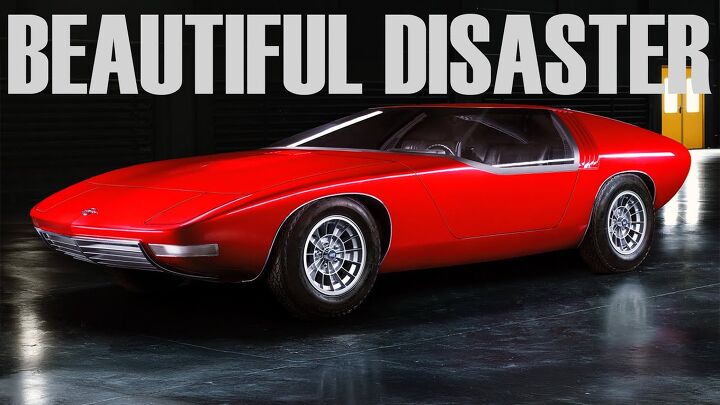

In the late 1960s, Opel had a problem. Not a mechanical one, but a spiritual one.
The company, despite being one of General Motors’ more profitable European divisions, had somehow found itself lumped into the same boring category as vacuum cleaners and toasters — functional, but about as exciting as a damp sandwich. It built cars for accountants, not dreamers, and what it desperately needed was a spark. Something to shake off the pipe-and-slippers reputation and remind Europe that Opel wasn’t just a badge on fleet cars and commuter boxes. And so, it decided to flirt with madness — by building a concept so beautiful, so futuristic, that it looked like it had rolled straight off a 1970s sci-fi film set. That car was the Opel CD, or Coupé Diplomat, a creation that would eventually give birth to one of the most elegant, short-lived GTs Germany ever produced: the Bitter CD.
The TTAC Creators Series tells stories and amplifies creators from all corners of the car world, including culture, dealerships, collections, modified builds and more.
A transcript, cleaned up via AI and edited by a staffer, is below.
[Image: YouTube Screenshot]
Become a TTAC insider. Get the latest news, features, TTAC takes, and everything else that gets to the truth about cars first by subscribing to our newsletter.
Transcript:
In the late 1960s, Opel had a problem. Not a mechanical one, but a spiritual one. Despite being one of General Motors’ more profitable European divisions, the company had somehow found itself lumped into the same uninspiring category as vacuum cleaners and toasters—functional, but about as exciting as a damp sandwich.
Opel built cars for accountants, not dreamers, and what it desperately needed was a spark—something to shake off its “pipe and slippers” reputation and remind Europe that it wasn’t just a badge on fleet cars and commuter boxes.
So, the company decided to flirt with madness by creating something bold, futuristic, and almost surreal—like it had rolled straight off a 1970s sci-fi film set. That car was the Opel CD, or Coupe Diplomat, a concept that would eventually give birth to one of the most elegant short-lived German GTs ever produced: the Bitter CD.
The story begins at the 1969 Frankfurt Motor Show, an event usually dominated by Mercedes and BMW showcasing their latest executive sedans. While others tried to impress, Opel—under the direction of GM’s European design team and the charismatic Chuck Jordan—arrived with something entirely different.
Styled by American designer George Gallion, who had been brought over from Detroit to add some flair, the CD was based loosely on Opel’s range-topping Diplomat, but shortened by nearly 10 inches and fitted with a low, sweeping body that made everything else in the hall look ordinary.
It was as if someone had asked what would happen if a Corvette and a spaceship had a child—and then built it out of fiberglass and pure optimism. Long, lean, and dramatic, it almost seemed better suited to an art gallery than the open road. The roofline melted into the rear with an elegance that even Mercedes’ W111 Paga coupe couldn’t match.
Then there was the party trick: a massive single-piece glass canopy that lifted forward like the cockpit of a fighter jet. There were no conventional doors—this thing didn’t open, it launched. Inside, the cabin looked like a lounge designed by someone who had just watched the moon landing and decided to live there.
It wasn’t a running prototype, but the potential was unmistakable. With Opel’s 5.4-liter Chevrolet-derived V8 under the hood, it could have been a grand tourer with both power and presence—a German take on the American muscle GT formula.
But when the dust settled after Frankfurt, two things were clear: Opel could design a car that made people stare, and GM had no intention of building it. Concepts were meant to inspire, not to exist. For most companies, that would have been the end of the CD story.
But this car struck a chord. Its shape was too perfect to remain a showpiece. The design world took note—and so did the Italians.
Fast forward to the 1970 Frankfurt Motor Show, where Pietro Frua, the Italian styling maestro behind countless Maseratis and Ferraris, presented his own evolution of the CD concept, commissioned directly by Opel.
This version was a more practical interpretation of Chuck Jordan’s design. The canopy was gone, replaced by normal doors. The proportions were slightly refined and more production-friendly. It looked just as stunning, but crucially, it could be built.
Paul Blowers, the famously blunt GM executive with a taste for risk and fast cars, became interested. Frua was asked to bring the CD to life as a low-volume grand tourer.
Unfortunately, Italian craftsmanship being equal parts genius and chaos, Frua couldn’t deliver quickly enough. Deadlines loomed, and reality set in: Opel was about to invest heavily in a V8 GT that would not only be expensive to build but would also compete directly with Chevrolet’s Corvette.
GM’s corporate logic prevailed, and the project was shelved. No production CD. No halo car for Opel.
But somewhere in Germany, a man named Erich Bitter was watching closely.
Bitter wasn’t a typical businessman. A former professional cyclist turned racing driver turned car importer, he had spent enough time around beautiful machines to recognize when something special had been wasted.
Frustrated with the inconsistent quality of cars he was importing from Intermeccanica, Bitter saw the Opel CD concept as exactly what a European grand tourer should be: elegant, powerful, and distinctly continental.
When Opel floated the idea of licensing the CD design to an independent company, Bitter seized the opportunity.
The arrangement was straightforward: Opel would supply the mechanical components—engine, transmission, and suspension—while Bitter would oversee the bodywork, interior, and assembly. The car would still resemble an Opel, but it would finally be built.
Bitter partnered with Baur, a German firm known for high-quality coachwork, and the result was spectacular.
When the Bitter CD debuted at the 1973 Frankfurt Motor Show, jaws dropped.
The proportions were pure Italian GT—think Maserati Ghibli with a hint of the De Tomaso Pantera—but with a level of German restraint and precision that kept it from feeling ostentatious.
Under the hood sat Opel’s 5.4-liter Chevrolet V8, producing 230 horsepower. It wasn’t exotic, but it had torque, reliability, and the ability to push the car to 130 mph—all while looking like it was breaking the sound barrier.
Inside, the cabin was finished with plush materials—leather, chrome, and deep carpets—arranged in a driver-focused layout that felt both luxurious and sporty.
The reaction was overwhelming. Bitter received 176 orders during the show—an incredible number for a brand-new independent manufacturer.
For a brief moment, it seemed like Germany had found its own answer to the Aston Martin V8 and Maserati Mexico.
But the timing couldn’t have been worse.
Just months later, the 1973 oil crisis hit. Fuel prices skyrocketed, and demand for thirsty V8 GTs evaporated almost overnight. Most of those 176 orders disappeared.
Production officially began in 1973, with each car built by hand. The price was steep—58,000 Deutsche Marks, roughly $23,000 at the time—meaning buyers could have purchased a Porsche 911 and still had money left over.
Bitter hoped to build 200 cars per year, but production was slow. By 1975, only 100 had been completed. By 1976, 254 cars had been built. When production ended in 1979, just 395 units existed.
Every car was left-hand drive and equipped with an automatic gearbox, reflecting Bitter’s target clientele: executives, industrialists, and celebrities who wanted something exotic but usable.
In that sense, the CD succeeded brilliantly. It was a grand tourer capable of crossing continents in comfort, combining GM reliability with handcrafted European elegance.
But like many passion-driven projects, it faded quietly. There was no second act for the original CD.
Its legacy continued with the Bitter SC in the 1980s, which added right-hand drive, manual transmissions, and broader appeal.
Still, the original CD remains a perfect snapshot of what happens when ambition collides with timing. It was a car too beautiful for the world it entered.
Born from GM’s global ambition, shaped by Italian artistry, and realized through German determination, it was ultimately undone by economics and geopolitics.
For those who have seen one in person, however, the impression is unforgettable.
