

“People in the auto industry never go away,” a friend said to me with some bitterness in his voice. “They leave one company—sometimes because they weren’t doing a very good job—then before you know it, they show up somewhere else with a better title.”
Sort of like whack-a-mole.
While that is certainly an unverified observation, it does seem true that the only people who have a better chance of getting another gig after leaving one are politicians, who show up as talking heads on CNN or Fox News almost instantaneously.
There is something to be said for having seasoned executives in leadership positions at companies. But, as said in a completely different context, “But if the salt loses its savor. . .t is no longer good for anything, except to be thrown out and trampled underfoot.”
I’m not suggesting that execs be trampled underfoot, but do think there is plenty to be said for having fresh people put in executive positions at OEM companies, especially people from outside the industry to spice things up.
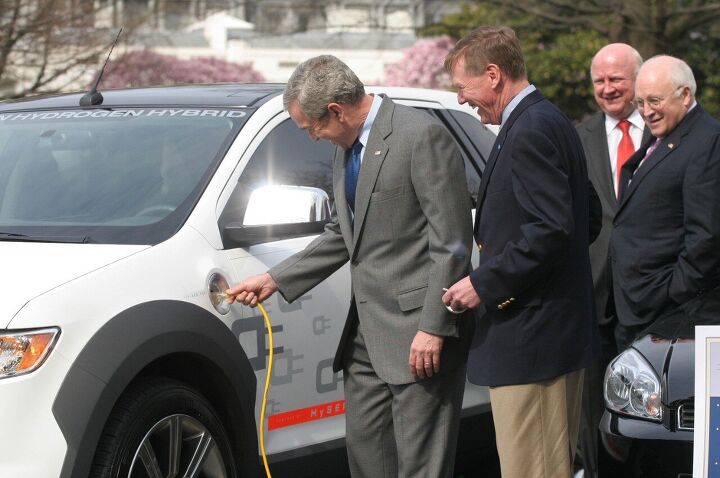
Clearly the individual who did a magnificent job when he rolled into Detroit from the West Coast was—no, not someone from Silicon Valley—Alan Mulally, an aerospace engineer who was with Boeing for 37 years before joining Ford in 2006, where he was until 2014. (Yes, Seattle counts as “West Coast.”)
Mulally, when he arrived, was not a “car guy.”
While it seems like ancient history, when Mulally became Ford CEO the company had reported a $12.7-billion loss, which was the result of things ranging from restructuring to a decline in sales of large SUVs and pickups due to rising gas prices.
Mulally made some bold moves, like essentially mortgaging everything the company had of value, from its factories to its Blue Oval logo, in order to secure a $23.6 billion loan to keep the company afloat (and to keep it from filing for bankruptcy, as its crosstown rivals eventually did).
Mulally also initiated the “One Ford Strategy,” which had Ford sell Jaguar, Land Rover, Aston Martin, and Volvo, and began selling its stake in Mazda (going to $0 in 2015).
Recently there have been efforts by OEMs to hire people from Silicon Valley in order to gain the resources necessary to have capabilities that are of-the-moment, something that an industry that has historically not had to be concerned with very much heretofore. But starting in the early oughts, when automotive designers became enchanted with Apple design, and in the early 2010s, when the Model S rolled out of Tesla Fremont, things changed.
While this can be a good idea—which seems to be the case with the hires of Doug Field and Alan Clarke by Ford (both were at Tesla at one point, and Field also has Apple on his resume)—at GM there have been several executive hires from places like Google and Tesla whose tenures haven’t exceeded a couple years, so there can be issues. (While it may be comparatively trivial in the larger scheme of things, finding/hiring/losing talent is not without a cost.)
One interesting somewhat-recent hire at GM is Sterling Anderson, who came from Aurora, the autonomous trucking company he co-founded and where he was chief product officer. (Anderson’s hire was announced on May 12, 2025, and he started on June 2.) Anderson has checked on his resume the seemingly obligatory Tesla box: whie there helaunched both the first-generation hardware for Autopilot and the Model X. He has a Ph.D. from MIT; his thesis: “Constraint-based navigation for safe, shared control of ground vehicles.”
Anderson is the executive vice president of Global Product and Chief Product Officer of GM. In that position he oversees hardware, software, services, and user experience, which seems sensible given his background, as well as EVs (there’s that Tesla experience coming into play), but also internal combustion vehicles.
Since he signed the employment contract EVs have become somewhat less important and internal combustion engines financially more important: remember that GM took $7.6 billion in write-offs and charges associated with its EV strategy.
Here’s a fun fact: It is estimated that there were approximately 340,000 Model X vehicles sold globally in its 11-year run (Q2 2026 will be the end of production); Chevy sold 362,909 light-duty Silverados in the US in 2025.
ICE vehicles are really important at GM, so EV experience is helpful but not as crucial as it was thought to be a mere number of months ago. Things are now changing more quickly than ever in the auto industry.
Which brings me back to my friend’s observation about execs and the release of the 2026 AlixPartners Disruption Index.
The consultancy surveyed 3,200 senior executives in 10 different industries and in 11 countries. Of that number, 320 are in the auto industry.
In addition to auto, the other industries are aerospace & defense, consumer products, energy, financial services, healthcare & life sciences, media & entertainment, retail, technology, and telecom & cable.
Is there a single one of those industries that are not under disruptive pressures?
For the second year in a row, auto has been calculated to be the “most-disrupted.”
Imagine being at a software company and looking at AI eating the whole thing, or at Warner Bros. and wondering whether you’re job is going to be safe after Netflix or Paramount takes over. And other industries on that list have disruptive forces they’re dealing with, yet auto takes the top spot on the list.
Among the disruptors are things ranging from “tariffs and other geopolitical actions” (although the survey was pre-Supreme Court decision, the tariff landscape continues to be fraught), competition from Chinese OEMs, software-defined vehicles, and more (if those aren’t enough).
But here’s the kicker: 43% of the auto execs are concerned that disruption in one form or another will cause them to lose their jobs.
As these disruptive forces are industry-wide in scope, presumably someone who loses her or his job as a result of not being up to the challenge for whatever reason is unlikely to show up somewhere else. Now that whack-a-mole isn’t as active.
And possibly those who have come in to the traditional auto industry with different perspectives—the Fields, Clarkes and Andersons—may be well suited for taking managing through the disruptions and will be looked back upon as Mulally-like in their bold accomplishments.
The industry needs it.
Long-time automotive journalist Gary Vasilash is co-host of “Autoline After Hours” and is a North American Car, Truck & Utility of the Year juror. He is also a contributor to Wards Auto and a juror for its 10 Best Interiors UX and 10 Best Engines & Propulsion Systems awards. He has written for a number of outlets, ranging from Composites Technology to Car and Driver.
The TTAC Creators Series tells stories and amplifies creators from all corners of the car world, including culture, dealerships, collections, modified builds and more.
Check out Gary’s Substack here. Republished with permission.
[Image: Ford]
Become a TTAC insider. Get the latest news, features, TTAC takes, and everything else that gets to the truth about cars first by subscribing to our newsletter.