
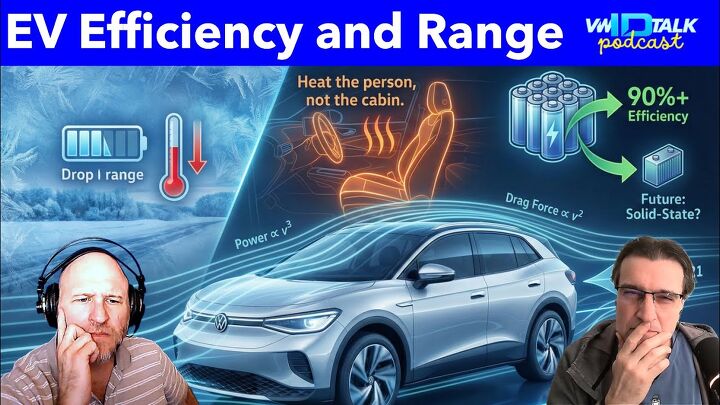

Why is your EV so efficient on paper, but loses range at high speeds or in winter? We walk through the physics of drag, battery vs fuel energy, heating losses, and what you can do to stretch every kWh in your EVs.
If this helped, hit subscribe ❤️. No sponsors—just enthusiasts paying for tools, parts, and late-night tinkering, research and video edits to bring real info to the VW EV community.
Check out the VWIDTalk Podcast on YouTube and wherever you get your podcasts ( Apple Podcasts, Spotify, Overdrive and more).
A transcript, cleaned up by AI and edited by a staffer, is below.
The TTAC Creators Series tells stories and amplifies creators from all corners of the car world, including culture, dealerships, collections, modified builds and more.
[Image: YouTube Screenshot]
Become a TTAC insider. Get the latest news, features, TTAC takes, and everything else that gets to the truth about cars first by subscribing to our newsletter.
Transcript:
How do you make air flow smoothly across a car? That’s where the coefficient of drag comes in. In simple terms, the lower the drag coefficient, the better. A lower number means the vehicle needs less power to overcome air resistance, which leads to lower energy consumption.
Welcome back to the VWD Talk podcast. We’re your hosts, Jan and Wes, and thanks for being here and subscribing. In addition to YouTube—where you can see all the visuals—we’re also available on OverDrive, Spotify, Apple Podcasts, and wherever you get your podcasts.
Today, Ryan had a great idea: let’s talk about EV efficiency. We’re going to get a bit technical, but we promise it won’t be boring. We’re looking at what affects driving range in an EV—and spoiler alert—it’s largely the same things that affect range in a gasoline car, or ICE vehicle, short for internal combustion engine.
So what actually affects efficiency?
Let’s break it into three topics. First, we’ll compare EV efficiency to internal combustion vehicles. Second, we’ll talk about energy density, specifically gasoline versus batteries. Third, we’ll look at aerodynamics and drag, and why they matter so much for EVs. Finally, we’ll look at how energy is actually used in an EV and how you can plan around that.
Alright, I’m interested. Let’s start with a quick quiz—maybe two.
Wes, imagine you have the energy equivalent of five gallons of gasoline. How far would a Golf GTI drive compared to an ID.4? Which one goes farther on the same amount of energy?
I’m guessing the EV goes farther.
More than twice as far?
Probably more than twice.
How about four times as far?
Wow. Okay.
And that’s because EVs are far more efficient. They operate at over 90 percent efficiency, while internal combustion engines are only about 30 to 40 percent efficient. The rest of the energy in gasoline is lost as waste heat.
Now, that waste heat does have a benefit in winter—you can use it to heat the cabin without extra energy. It also helps bring the engine up to operating temperature. With an EV, you don’t get that for free. You have to actively heat the battery and the cabin.
That’s more than I expected.
Now for the second quiz. If you fully fuel a Golf and fully charge an ID.4, how much energy is actually stored in each vehicle?
Gasoline is extremely energy-dense. That’s why airplanes still rely on it—batteries simply don’t store enough energy for their weight. So the Golf is carrying far more energy.
Exactly. A 13-gallon (50-liter) tank of gasoline contains roughly half a megawatt-hour of energy. If an EV could carry that much usable energy, it could theoretically drive over 1,500 miles.
That really puts efficiency into perspective.
The real limitation with EVs isn’t efficiency—it’s energy storage. EVs are incredibly efficient, but current batteries only store the equivalent of about two gallons of gasoline.
So the takeaway here is that internal combustion vehicles waste about 70 percent of their energy as heat, while gasoline has a much higher energy density than today’s EV batteries. Solid-state batteries may change that, but we’ll see when they actually arrive.
Here’s an interesting point. If you’re an automaker trying to improve the efficiency of a gasoline car, you focus on the engine because that’s where most of the losses occur. With EVs, the drivetrain is already very efficient, so the next big challenge becomes aerodynamics.
It’s not that aerodynamics don’t matter for ICE vehicles—it’s just that engine inefficiency overwhelms everything else. With EVs, small aerodynamic improvements can make a meaningful difference in range.
And the good news is that these aerodynamic tricks often make their way into ICE vehicles too. EV development is actually making gasoline cars more efficient, which is a bit ironic—but we’ll take it.
Now let’s talk about the physics. When you drive, there’s a force acting against the car called aerodynamic drag. That force increases with the square of your speed. Double your speed, and drag force increases fourfold.
But here’s the kicker: the power required to overcome that drag increases with the cube of speed. Double your speed, and you need eight times the power.
That’s wild.
And power draw is directly related to energy consumption. So driving faster dramatically increases how much energy you pull from the battery.
Other factors include air density, which varies with temperature and altitude. Cold air is denser, so winter driving can slightly increase drag.
This drag equation applies to any object moving through air—a car, a truck, even a brick.
Manufacturers can control two things here: frontal area and drag coefficient. Frontal area is basically the silhouette of the car if you shine a light at it. Bigger vehicles like SUVs and trucks have larger frontal areas, and that’s mostly dictated by vehicle type.
The drag coefficient, however, is something manufacturers can actively improve. That’s all about how smoothly air flows over the vehicle.
A typical SUV might have a drag coefficient around 0.38. The ID.4 is closer to 0.28, which is better than you might expect. Surprisingly, the ID. Buzz has a similar drag coefficient—the issue there isn’t drag, it’s frontal area.
Sedans really shine here. Vehicles like the Mercedes EQS, Hyundai Ioniq 6, Audi A6 e-tron, and VW ID.7 are down around 0.20 to 0.21. For context, an older Audi A4 sedan had a drag coefficient around 0.27. Today’s EV SUVs are as slippery as older ICE sedans.
That’s impressive.
To summarize the physics: doubling your speed—from 30 to 60 mph, or 40 to 80—requires eight times the power to push through the air. That’s why EVs are most efficient at lower speeds, and why highway driving hits range so hard.
EVs also benefit from regenerative braking in stop-and-go traffic, which helps city efficiency.
Now let’s talk about where energy goes in an EV, especially in cold climates. Roughly 50 percent goes toward propulsion. Another 20 to 30 percent can go toward heating—both the cabin and the battery.
Because EVs don’t produce waste heat like ICE vehicles, all that heat has to come from the battery. Some vehicles use heat pumps, which are much more efficient. A heat pump can turn one kilowatt-hour of energy into up to three kilowatt-hours of heat.
In winter, you can see a 20 to 30 percent range hit, largely due to heating. Cabin heaters can draw several kilowatts, and battery heaters can draw even more, especially during warm-up.
One way to reduce that impact is preconditioning—warming the battery and cabin while the car is still plugged in. That way, you’re using grid power instead of battery power.
Another tip is to use seat heaters and a heated steering wheel instead of cranking up the cabin temperature. It’s far more efficient to heat people than to heat air, especially in a car that isn’t insulated like a house.
Of course, comfort matters. If charging isn’t a concern and time isn’t tight, there’s no need to suffer.
To wrap things up: EVs are far more efficient than internal combustion vehicles. Their main limitation is battery energy density, not efficiency. Aerodynamics matter enormously, especially at highway speeds. And in winter, heating plays a big role in range—but smart habits can help reduce the impact.
Thanks for sticking with us. If you enjoyed this breakdown, follow the VWD Talk podcast. Our next episode will dive into regenerative braking, so be sure to subscribe so you don’t miss it.
Thanks for watching. Bye.
