
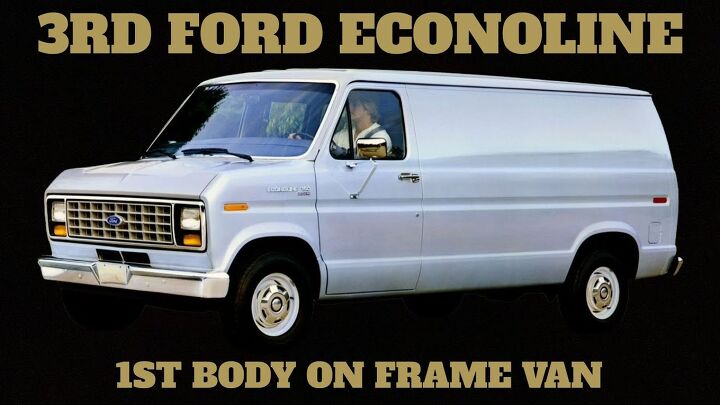

The 1975 Econoline and Club Wagon Van was a complete redesign for Ford Vans.
Once again Ford was going to offer something new in the full size van segment, Body on Frame construction. Ford held the leadership position in Full size van production since the debut of the Econoline by offering something its competition hadn’t. Would this time be different?
For more Ford related content subscribe here: https://www.youtube.com/c/TonysFordsa…
The TTAC Creators Series tells stories and amplifies creators from all corners of the car world, including culture, dealerships, collections, modified builds and more.
A transcript, created by AI and edited by a staffer, is below.
[Image: Tony’s Fords and Mustangs/YouTube]
Become a TTAC insider. Get the latest news, features, TTAC takes, and everything else that gets to the truth about cars first by subscribing to our newsletter.
Transcript:
The 1975 Econoline and Club Wagon represented a complete redesign for Ford Motor Company. Once again, Ford aimed to bring something new to the full-size van segment—this time with bolt-on frame construction. While body-on-frame design was not new technology, it was new to the full-size van market. Ford had maintained its leadership position through the previous two generations by offering features its competitors did not, and the new frame construction fundamentally changed the van’s appearance. For the first time, the Econoline featured a pronounced front nose, something no other van offered at the time. The question was whether this change would affect sales or if Ford could retain its leadership position.
To answer that, it’s worth taking a closer look at the third-generation Econoline and Club Wagon.
Ford introduced the redesigned Econoline in September of 1974 as a 1975 model. The new body-on-frame construction allowed for higher GVWR ratings and improved the van’s ability to handle heavier loads. Wheelbases were extended to 124 inches for the standard van and 138 inches for the long-wheelbase version, making it the longest wheelbase available in the market at the time. This change also allowed Ford to move the engine forward by 18 inches, giving occupants the ability to move freely between the front seats and access the cargo area more easily.
The van’s body was entirely new, with a more squared-off design at all corners. The front end was extended with a longer hood and fenders, and the hood itself was now twice as long as before. Up front, the van featured a large rectangular grille, two headlamps, and turn signal indicators. Along the sides, longer driver and passenger doors improved entry and exit. Buyers could choose either rear barn doors or a sliding passenger-side door. At the rear, taller and slimmer taillight housings allowed the cargo doors to open 5.4 inches wider, making loading easier.
Inside, the Econoline was restyled to improve comfort and usability. The steering wheel angle was revised for a more natural driving position, and the dashboard was completely redesigned with clearer gauges. Switches, the radio, and climate controls were repositioned within easier reach of the driver. Ford also added standard storage bins and an ashtray on top of the engine cover.
The Econoline lineup included four load ratings. The E-100 had a maximum GVWR of 5,800 pounds, the E-150 increased that to 6,300 pounds, the E-250 stepped up to 8,500 pounds, and the E-350 topped out at 10,000 pounds.
Engine options began with the standard 119-horsepower 300 cubic-inch 4.9-liter inline-six. Optional engines included a 153-horsepower 351 cubic-inch 5.8-liter Windsor V8 with a two-barrel carburetor, and for E-250 and E-350 models, a 215-horsepower 460 cubic-inch 7.5-liter V8. Electronic ignition became standard across the lineup for 1975. A three-speed manual transmission remained standard, with Ford’s Cruise-O-Matic three-speed automatic available as an option, except on the E-350, which was automatic only.
Suspension updates included Ford’s Twin I-Beam front suspension and heavier rear leaf springs. Power front disc brakes became standard, while the rear used power drum brakes. For the first time, Ford also introduced a foot-operated parking brake in a van.
Standard features included low-back bucket seats, color-keyed trim, a heater and defroster, washer jets mounted on the wiper arms, dome lamps for the front and cargo area, insulated floor mats, color-keyed armrests, a coat hook, argent bumpers, and hubcaps. Optional equipment ranged from power steering and high-capacity air conditioning to an AM/FM stereo with tape player, intermittent wipers, a rear step bumper, and multiple trailer towing packages.
The Club Wagon was offered in standard, Custom, and Chateau trims, each available with seating for five, eight, or twelve passengers. Custom models added woodgrain trim, upgraded interior panels, full-length floor mats, aluminum scuff plates, and bright exterior accents. The Chateau trim went further with upgraded vinyl seating, full carpeting, woodgrain door panels, a vinyl headliner, and additional exterior brightwork.
Additional options included swivel captain’s chairs, cruise control, privacy glass, auxiliary fuel tanks, two-tone paint schemes, and camper packages. Ford also offered the Econoline as a cutaway chassis, allowing for box trucks, RVs, and motorhome conversions.
The automotive press praised the Econoline’s expanded capabilities, though some noted the new design might take time to grow on buyers. In practice, the public adjusted quickly. Ford sold 124,569 Econoline and Club Wagon vans during the 1975 model year.
For 1976, changes were minimal, with cloth seat inserts becoming available. Sales increased to 147,380 units. In 1977, Ford introduced the Cruising Van package, offering factory customization with unique wheels, tape stripes, sports instrumentation, captain’s chairs, and a fully carpeted interior. Sales remained strong at 138,064 units.
The 1978 model year brought a four-speed manual transmission and a long list of new options, including sport steering wheels, tilt columns, aluminum wheels, roof racks, and handling packages. Sales surged, with Ford delivering more than 238,000 Econolines and over 44,000 Club Wagons.
In 1979, Ford introduced the Super Van, extending cargo length by 20 inches and increasing passenger capacity to 15 in Super Club Wagon models. A 302 cubic-inch V8 joined the engine lineup, and exterior updates included square headlights and revised grille branding. Sales remained strong through the end of the decade.
Throughout the 1980s, the Econoline saw incremental updates including new engines, fuel injection, revised trim levels, electronic engine controls, and additional convenience features. Despite limited year-to-year changes, Ford consistently retained its title as the best-selling van in America.
By the early 1990s, it was clear the bold redesign introduced in 1975 had not hurt sales at all. After a brief adjustment period, buyers embraced the Econoline’s versatility. It could haul passengers, cargo, or serve as the foundation for ambulances, buses, RVs, and campers. The full-frame Econoline proved adaptable across countless applications.
In 1992, Ford would introduce the final generation of the Econoline—a story for another time.
If you enjoyed this video, please consider liking and subscribing. Thanks for watching, and we’ll see you next time.