
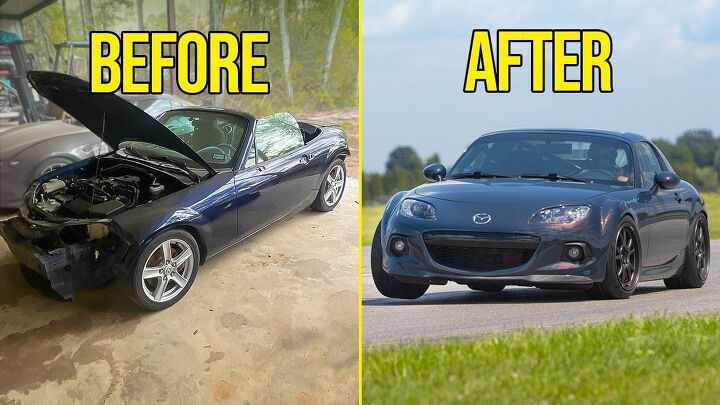

Our friends at Speed Academy have another build for you to check out.
This one involves a Mazda Miata and a K-Swap. Check it out below.
Speed Academy is a website and YouTube channel based on making things go fast and enjoying cars. Peter Tarach and Dave Pratte are the forces behind Speed Academy.
The TTAC Creators Series tells stories and amplifies creators from all corners of the car world, including culture, dealerships, collections, modified builds and more.
[Image: Speed Academy/YouTube Thumbnail]
Become a TTAC insider. Get the latest news, features, TTAC takes, and everything else that gets to the truth about cars first by subscribing to our newsletter.
Transcript:
Welcome to our K-swap NC Miata build.
This NC Miata started life as a crashed car out of Louisiana that we sourced through Go Moto. They picked it up at auction for $3,500 and then rebuilt it to our specifications, including this custom paint finish in Ford Mustang Dark Horse. They also refreshed the factory Club Spec components, deleted the soft top, and fitted a DG Motorsports hardtop.
What you see here is everything required to complete a K-swap in an NC Miata. This is a fully turnkey solution—every single component needed to convert the car to Honda K-series power. To get the job done as quickly as possible, we had Dave and Louis from KPower Industries on hand. They claim the swap can be completed in about two days.
While we did manage to finish in roughly that time, we cheated a little by working late into the second night. Realistically, if you’re doing this at home, expect the swap to take a couple of weekends.
A few hours in, the factory MZR engine was already on the floor. These engines typically make around 140 horsepower at the wheels. By comparison, the K-series engines we’re installing make anywhere from 210 to 230 wheel horsepower, depending on configuration.
We dropped the front subframe because the KPower kit includes a custom front subframe designed to clear the Honda K24 oil pan while retaining all factory suspension pickup points.
With the K24 on the stand, we laid out the parts needed to adapt it to the NC. We also kept the original MZR engine nearby to reuse several components, including the power steering pump, AC compressor, idler pulley, and various clamps. One of the standout features of this swap is that it retains the NC’s factory power steering pump and AC compressor, which means factory-like steering feel and air conditioning performance without sourcing additional components.
While the engine was out, we refreshed the timing system. These engines are known for tensioner failures, chain stretch, and worn guides, so addressing this upfront made sense. We also swapped in a K20 50-degree VTC cam gear, which provides a greater cam timing adjustment range than the 25-degree unit found on the K24.
Unlike many K-swaps that convert to a K20 oil pump, we intentionally retained the K24 oil pump with its balance shafts. While switching to a K20 pump reduces rotating mass, it also increases NVH. Our goal was refinement, so keeping the balance shafts—combined with factory rubber NC engine mounts—helps the car feel closer to a stock TSX in character.
If you’re using a JDM K24, note that you’ll need a USDM water pump housing, as it includes the necessary mounting points for the alternator. KPower handles the remaining details required to configure the engine for rear-wheel drive use.
Once assembled, the engine looked essentially OEM. The intake manifold placement keeps the throttle body in a factory-like position, the oil filter is relocated for clearance, and a K20 crank pulley underdrives the accessories. This is critical, as over-spinning the NC power steering pump would cause reliability issues.
We installed a Bosch 74-millimeter drive-by-wire throttle body. While the manifold supports cable throttles, drive-by-wire allows us to fully leverage the Haltech Elite 1500 ECU, including features like auto-blip downshifts, no-lift shifting, and integrated traction control.
With the engine harness installed, we transferred the suspension and steering components to the KPower front subframe. A small notch was required in the transmission bellhousing to clear the starter, after which the engine was installed. This kit is designed to work with the factory NC manual transmission. Ours is a five-speed, though the six-speed is considered more robust for track use.
We installed the K-swap header, a compact 4-2-1 design that works in several rear-wheel-drive applications, followed by the power steering and optional stainless exhaust system.
Once the AC lines, fuel system, coolant lines, and wiring were connected, the engine bay was essentially complete. The Haltech Elite 1500 ECU replaces the factory ECU entirely, running the car over the CAN bus so that gauges, windows, and locks continue to function as intended.
After installing the intake, the car fired up and ran exactly like an OEM setup. From there, attention shifted to the rest of the chassis. This being a high-mileage 2007 car, we removed the open differential and replaced it with a 1.5-way clutch-type limited slip unit. Suspension components were refreshed throughout, replacing worn rubber bushings with spherical bearings for zero deflection and improved alignment control.
We installed a baffled oil pan to improve oil control under track conditions, replaced sagging engine mounts to restore clearance, and upgraded the radiator to a high-capacity aluminum unit. Hardrace control arms were used throughout, providing camber adjustment and durability.
At the rear, the refreshed differential and new bushings were installed, followed by a full nut-and-bolt torque check of the chassis. We also replaced the standard battery with a lightweight unit, saving roughly 25 pounds from ahead of the front axle.
To improve safety, we removed the hardtop and installed a roll bar, followed by racing seats mounted on PCI rails. A Momo Monte Carlo steering wheel replaced the factory unit, along with a new shift knob.
The DG Motorsports street hardtop was installed, saving over 40 pounds compared to a factory hardtop. Wheels and tires were upgraded, and final dyno testing showed 218 horsepower and 175 lb-ft of torque at the wheels—strong numbers given rear-wheel-drive drivetrain losses.
Exterior upgrades included carbon fiber aero components, refined wheel fitment, and a custom CAN-based digital display system. The finishing touch was a full race livery in preparation for GridLife’s Circuit Legends Festival at Lime Rock Park.
That’s the K-swapped NC Miata project in a nutshell. For a deeper dive into every step of the build, check out the full video series on the channel. Thanks for watching.
