

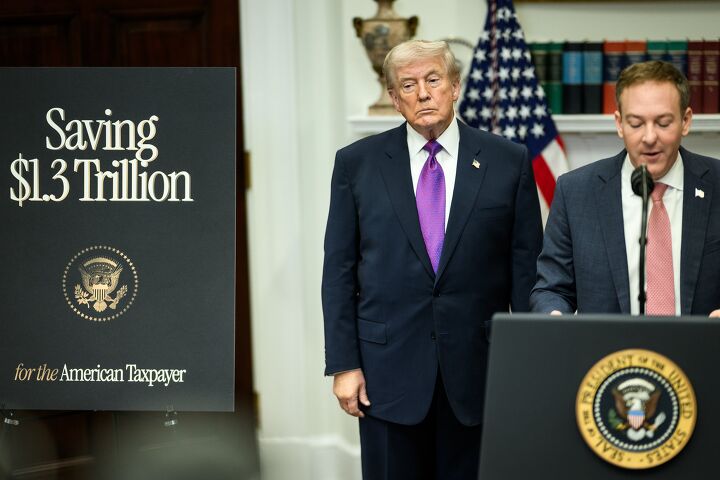
As part of the Environmental Protection Agency’s recent celebration regarding its repeal of the endangerment finding and status of automatic stop-start, there was a somewhat dubious claim suggesting the government could save Americans $1.3 trillion by 2055. With the EPA issuing a follow-up regulatory impact analysis, some are now claiming that the math isn’t working. However, some of their numbers are looking equally suspect.
Assertions have been made by Bloomberg , The Guardian, and Mother Jones that the agency’s cost-benefit analysis actually shakes down to the United States incurring an additional $1.4 trillion in expenses over the same 30-year timeframe. Claims hang upon a single chart that outlines increased costs pertaining to additional vehicle repairs, maintenance, fuel purchases, insurance premiums, traffic congestion, and something as seemingly arbitrary as “noise.”
Meanwhile, the EPA is hanging the brunt of the presumed savings on automakers not having to adhere to stringent emission regulations resulting in higher development costs, increasingly expensive automobiles, and taxpayers avoiding industry subsidization. The Trump administration estimates that drivers could see as much as $1.14 trillion in savings by 2055 by bucking the current regulatory strategies, with another $200 billion coming from automakers not needing to develop so many all-electric models and the related EV charging infrastructure.
The EPA document references Princeton University’s Zero-carbon Energy systems Research and Optimization Laboratory suggesting that removing tailpipe emission regulations and the remaining federal clean vehicle tax credits (from the Biden-Harris Inflation Reduction Act) would reduce the sales of BEVs by about 30 percent in 2027 and 40 percent in 2030. Additional studies from the Salata Institute for Climate and Sustainability at Harvard University likewise supported claims that moving away from government subsidization would lower EV adoption rates. The EPA framed this as a good thing, citing slow adoption rates from consumers as referenced by Cox Automotive.
In the agency’s regulatory impact analysis, assertions were made that it would financially irresponsible to keep investing money into electrification initiatives and emission-compliance tech customers don’t seem eager to purchase and likely wouldn’t even sell without sustained government funding. The rest of the paper revolves around future energy prices and the financial impacts of abolishing select emission policies (e.g. EV tax credits, Corporate Average Fuel Economy requirements, California’s Advanced Clean Truck and fueling waivers, etc.)
The problem is that basically every single data point is speculative unless it’s referencing something that has already happened. Granted, the report attempts to cope with this by using numerous data models striving to predict what things will be like in 2055 under varied scenarios. But divining the future is something the people of the past have historically struggled with, which the EPA’s regulatory analysis acknowledges directly.
For example, one of the biggest variables the impact analysis has to cope with is trying to guess what fuel and electricity prices will be decades down the road. Some of the scenarios assert that electricity prices are poised to skyrocket due to data farms and energy needs pertaining to artificial intelligence. There are reasons to buy into that assumption, too. The areas that have allowed those installations to be built have seen major increases in energy demand, sometimes resulting in the price of electricity ballooning by anywhere from 100-300 percent.
Previous studies have also suggested that pivoting the entire nation to all-electric vehicles would have similar results on the cost of energy — potentially nullifying many of their claimed financial benefits over internal combustion vehicles.

But the above assumes fuel prices will remain stable, which is also something the report makes some rather broad assumptions about. Deregulation of the industry so it can be freed up to produce more traditional automobiles only really works if manufacturers actually bother to do so and U.S. oil valuations play along. However, it’s hard to have faith in automakers and insurance firms as they’ve both increasingly prioritized “shareholder value” over customer satisfaction.
This is to say nothing regarding how one attempts to determine decades of costs based upon things like congestion, noise, refueling time, and “drive value” — all of which are in the report and being leveraged by both sides without a truly satisfactory explanation on precisely how they are calculated or relevant to the conversation.
Here’s what’s actually happening: The Trump administration wants to sell the public on the concept of deregulating the industry whereas its opponents want to do the exact opposite. The former was shown via the EPA’s recent announcements, while the latter is showcased in the recent coverage by media outlets like Mother Jones and The Guardian.
From The Guardian:
The administration’s analysis also fails to examine the additional costs that deregulation could create due to increased global warming, which experts say could be massive. “This is aligned with what we’ve been seeing from this administration, where they focus on the cost to industry while completely ignoring the costs to the health and climate costs,” said [Kathy Harris, head of clean vehicle programming at the environmental nonprofit Natural Resources Defense Council].
Repealing the endangerment finding could increase the country’s greenhouse gas emissions by a stunning 10 percent by 2055, and impose up to $4.7 trillion in additional expenses tied to harmful climate and air pollution by that time, according to projections from advocacy group the Environmental Defense Fund.
Critics say the repeal will benefit Trump’s wealthy oil-boss donors while harming the working class and vulnerable Americans.
“Like most actions within this administration, this decision lacks any regard for everyday people and seems to be a play to deepen its loyalty to fossil fuel companies and billionaires who have proven that they are willing to take actions that endanger human life,” said Abre’ Conner, the director of climate and environmental justice at the NAACP.
The EPA spokesperson said: “These activists picked winners and losers and regulated our economy to the tune of trillions at the expense of the American people with zero measurable environmental impact to show for it. The people who are expressing outrage now are simply upset that their preferred ideology can no longer bypass Congress and the will of the people to dictate how Americans live, work, and drive.”
That EPA spokesperson makes a salient point. The Clean Air Act and subsequent Obama-era regulations proved exceptionally expensive and have effectively been driving the trajectory of the automotive industry for decades. But they haven’t resulted in more-affordable vehicles or even a meaningful improvement in the nation’s practical fuel-economy averages. We’ve fallen short of the targets laid out in the late 2000s, which the Obama administration even suggested might be untenable.
At the same time, the previous Biden-led initiatives saw unfettered government spending going toward advancing clean energy initiatives, EV charging infrastructure, and continuing to subsidize all-electric vehicles that people simply weren’t purchasing in great numbers. With all this talk about how much money will be spent through 2055, everyone seems to have forgotten that the federal government spent an estimated $1.6 trillion (between 2022 and 2026) in authorized federal funding toward its own climate agenda — with a meaningful slice of that sum going toward EVs and the requisite charging infrastructure.
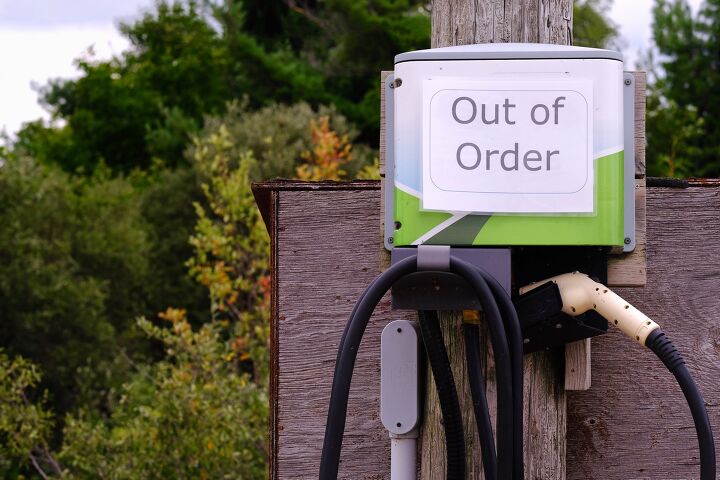
However, while I’m pleased to chide an outlet like The Guardian for being willfully ignorant of the government spending a fortune on climate agendas and attempting to frame deregulation as somehow racist, it still made some good points. For example, it noted that the Trump administration’s EPA regulatory analysis used a report from the Energy Information Administration (EIA) that accounted for “policies being implemented by President Trump that are intended to drive down the price of gasoline.”
The Natural Resources Defense Council’s Kathy Harris claimed that was not necessarily representative or reality and was designed to showcase a best-case scenario to suit its agenda.
“That EIA’s low oil price [scenario] was never meant to show the effect of any policies that Trump would implement,” she told the outlet. “It’s designed to showcase the uncertainty and the volatility of domestic oil prices due to international forces on the global oil market that drives gas prices in the US and abroad.”
“They’re cooking the books here,” she added.
Considering your author made the same claim earlier in the article, that’s certainly a fair analysis. But the allegation that “they’re cooking the books” can be thrown right back at Harris, who leverages broad assumptions regarding climate change to make her point. She also literally works for an environmental advocacy group and is paid to advance a specific agenda.
We absolutely cannot ignore the fact that there is a lot of money in the business of environmentalism. The United Nations even acknowledged that environmentalism and the clean energy industry had actually overtaken Big Oil in terms of capital investments. This includes governmental agencies, NGOs, advocacy groups, equipment/vehicle manufacturers, tech companies, and green energy providers (many of which are ironically subsidiaries of oil or natural gas companies).
In 2024, clean energy investments were estimated to be roughly $2 trillion — nearly double what Big Oil saw that same year. But oil companies still see significantly higher revenues while environmentally focused expenditures continue to see fractional returns on investments. But this is rarely brought during public debates about which regulatory policies should be advanced.
Both sides of this tedious argument are instead throwing around truly ludicrous numbers and making a lot of unsubstantiated claims regarding how repealing the 2009 endangerment finding study as the basis for how the United States regulates its automobiles will impact the economy. Some of that is admittedly unavoidable. Asking a group to determine the financial impact of regulatory policies 30 years down the line is a monumental undertaking — likely bordering on impossible.
At best, we can presume everyone is a good-faith actor making educated guesses and doing what they can to avoid letting the relevant industries influence them. But that seems extremely, perhaps even foolishly, generous. Climate alarmism has been used to rationalize the government taking some rather extreme counter measures, with the end result often being sending a bunch of money to the usual suspects. It could likewise be argued that the resulting regulatory policies have come with some rather severe drawbacks, rather than obvious victories for the general public.
However, it’s not evident that the Trump administration has come up with an obvious solution. Decoupling emission regulations from the executive branch would be more desirable if citizens felt Congress could be decoupled from special interests. Meanwhile, the data being pushed by today’s EPA doesn’t offer much more clarity than what we’ve seen under the previous administrations.
There’s also not much to suggest that automakers are collectively going to make a big play to build more affordable, reliable automobiles for North America now that some meaningful deregulation has been implemented. Most companies have global ambitions and many markets are still pushing environmental policies above everything else (e.g. Europe). We similarly cannot know what fuel or electricity prices are going to be years from now, which is to say nothing of the broader economy.
The entire issue feels like two groups bickering over how best to abandon a sinking ship while blocking the other party from accessing the point of egress. I would encourage everyone to read the “Rescission of the Greenhouse Gas Endangerment Finding and Motor Vehicle Greenhouse Gas Emission Standards Under the Clean Air Act Regulatory Impact Analysis” in full before making up their mind. But I would be lying if I said that it has all the answers.
It’s basically a sales pitch for the deregulation plan that cites a bunch of speculative numbers. However, that’s also what we’ve been getting from the other side of the aisle since about 1970. With impartial voices largely absent from the conversation and sound metrics being difficult to find, it may just be better to view this as a matter of faith.
For me, that means bucking the status quo and accepting whatever environmental risks follow deregulation. Decades of seemingly arbitrary environmental targets driving vehicle designs and objectively poor implementation have helped me decide where to draw a line in the sand. But it’s still very loose ground. I could always be wrong and would certainly be regretting my decision if the sea does end up rising to swallow the vehicles in my driveway. On the upside, nobody will have to endure partisan bickering about government regulations once we’re all underwater.

[Images: The White House; Standret/Shutterstock; VisualArtStudio/Shutterstock; DenisProduction.com/Shutterstock]
Become a TTAC insider. Get the latest news, features, TTAC takes, and everything else that gets to the truth about cars first by subscribing to our newsletter.
