
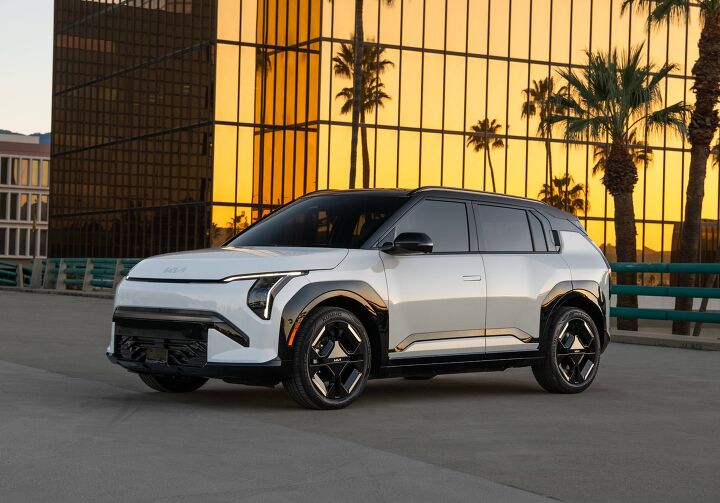
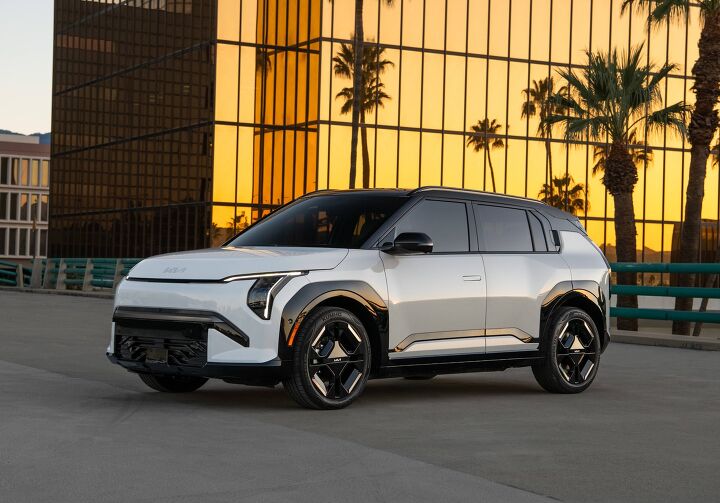
Although electric vehicle sales have been down since last fall, the reveal of the all-new EV3 at the New York International Auto Show shows that Kia’s not bailing out of the segment.

“The Kia EV3 represents a bold step forward in our commitment to making electric mobility accessible to more Americans,” said Eric Watson, vice president, sales operations, Kia America. “With its striking geometric design inspired by EV9, advanced technology, and spacious interior, the EV3 brings the innovation of our EV lineup into an entry EV SUV tailored for the way U.S. customers live, work, and travel.”
The company already sells the EV3 in other parts of the world and has since the second quarter of 2024. It will go on sale in the U.S. in late 2026. Pricing will be announced closer to the EV3’s on-sale date. Its ties to the EV9 are very clear with the boxy, upright silhouette being the most noticeable link between the two battery-electrics, although it does feature a sloping roof that EV9 does not. It’s smaller than the EV9 and EV6.
It will be available in five trim levels: Light, Wind, Land, GT-Line, and GT. It’s designed to be a useful, flexible crossover with good range to allow owners to carry on life as usual. The range is as high as an estimated 320 miles, and using a DC fast charger, the 400V Light model can be charged from 10 percent to 80 percent in about 29 minutes, officials noted. The larger battery takes two minutes longer to do the same. All versions come standard with the NACS charging port.

There are two battery options: a 58.2 kWh battery for the Light while the remaining trims get the larger 81.4 kWh battery. The Light will charge faster, but it’s necessary with a range of just 220 miles compared to the 320 miles the larger battery can provide. There is a performance-oriented model, the GT, which puts out 288 horsepower, and can be had with Virtual Gear Shift and Active Sound Design to simulate a manual driving experience.
The other models with the larger battery develop 261 hp on the all-wheel drive (AWD) models, which is only an option with the larger battery. Front-wheel drive (FWD) is standard, and drivers can experience one-pedal driving, which Kia calls i-Pedal. This allows the driver to modulate the accelerator pedal to control speed, pressing down — of course — when faster is needed. However, lifting up slows the vehicle down and that energy is captured and added back to the battery.
On the inside, the Opposites United strikes again with an airy cabin complemented with “durable” materials designed to look premium. Openness is the key word, which allows for a simple layout with flexible storage and easy access to everything in the front of the driver. The cargo space features 26.1 cubic feet of space behind the second row. If you need more, fold the 60/40 split bench down, and it expands to 56.5 cubic feet.

The EV3 features a standard panoramic display comprised of a 12.3-inch instrument cluster, 5-inch climate display and a 12.3-inch infotainment screen. These are the building blocks of Kia’s connected car Navigation Cockpit, or ccNC, which also started in the EV9. This set up allows owners to personalize their space with themed dashboard functions, including specialized graphics.
Other available convenience, tech and connectivity features include a 12-inch head-up display (HUD), a premium eight-speaker Harman Kardon audio system, wireless smartphone charging, and 360-degree Surround-View Monitor (SVM). The EV3 also gets a suite of advanced driver safety systems, such as Forward Collision Avoidance Assist, which can brake in emergency situation to avoid a crash or try to mitigate the impact of one, officials noted.
[Images: Kia]
Become a TTAC insider. Get the latest news, features, TTAC takes, and everything else that gets to the truth about cars first by subscribing to our newsletter.
