
While Newton’s Laws of Motion aren’t completely aligned with this notion, once something gets a push forward, it starts going. If it gets more pushes along the way, not only does it keep going, but it might accelerate.
And it goes merrily along until there is something that impedes that forward motion.
Momentum is reduced, perhaps putting that object in a state where it is limping along, perhaps on its way to a complete stall.
Which brings me to Norway and Minnesota.
In 2025, of all the new vehicles registered in Norway, 95.9 percent were electrified. Most of those 179,549 vehicles—172,232—were full battery electric. There were also 2,751 plug-in hybrids.
ICE vehicles registered? 487.
This didn’t happen just because a whole lot of Norwegians decided they liked Teslas. (Although there were a whole lot of Norwegians who got Teslas in 2025, with the brand accounting for 20 percent of overall EV sales.)
Nor did this happen overnight.
In 1990 the Norwegian government temporarily lifted an import tax for EVs. (Norway doesn’t have a vehicle manufacturing infrastructure, so all vehicles are imported.) That tax relief was made permanent in 1996. What’s more, there was a reduction in annual road taxes paid for drivers of EVs in 1996, followed by a lifting of road tolls in 1997.
In 1999 free municipal parking was instituted for EVs.
Then there were reduced taxes on company cars in 2000 and an exemption from a 25% value-added tax in 2001.
2005 saw EVs getting access to bus lanes and 2009 free rides on car ferries.
Now on the one hand this was being done for what can be considered altruistic reasons, as in reducing greenhouse gas emissions.
On the other, there is the fact that about 98% of Norway’s electricity is generated by hydropower, so they’ve got that in abundance.
None of these efforts to encourage the purchase of EVs are free, of course.
It is somewhat ironic that Norway’s Government Pension Fund Global is the world’s largest sovereign wealth fund, with considerable monies coming from the country’s North Sea oil and gas reserves, so oil and gas are helping fund the EV transition.
The taxes cut on EVs are partially offset by tax increases on ICE vehicles.
Certainly the country is “losing” money through its efforts. But a country isn’t a business and while debt is not a good thing (though this is not an issue with Norway), governments ideally exist to serve its people, and if serving its people means reducing greenhouse gases through various efforts, then the taxes it isn’t imposing on EVs are worth the loss.
Norway, of course, is not the U.S.
Geographically, it is about the size of Montana.
Demographically, it has about as many people as Minnesota.
According to Drive Electric Minnesota, a public-private partnership established to increase the number of EVs in the Gopher State, as on July 1, 2025 there were 78,679 electrified vehicles on the road in the state: 55,123 EVs and 23,556 plug-in hybrids. That’s 1.03% of all the vehicles on the road in Minnesota.
And then there’s this from a Drive Electric Minnesota presentation made in late October 2025:
“EVs will become more expensive to operate in Minnesota
· State and federal purchase incentives eliminated
· Federal refueling infrastructure tax credit being phased out
· Higher annual EV fee in Minnesota
· Public charging tax beginning in 2027, on top of already sharply rising costs for public fast-charging, which is still an early market”
The state instituted a new EV and PHEV surcharge in 2025 for road maintenance. The state had been charging a flat $75 annually for EVs. It is now doubled.
Drive Electric Minnesota ran the numbers and found that if someone drives a gas-powered Toyota Corolla, there will be an average annual gas tax of $127. If that same someone were to buy a Tesla Model 3, the annual fee during the first year of ownership would be $221.
A Ford F-150 would have an average gas tax of $211. An F-150 Lightning $325.
Not exactly incentivizing the purchase of EVs.
This year Norway is going to roll back some of its EV incentives, like on the VAT incentive. Presumably the government figures the forward momentum in the market is such that people will continue to purchase EVs*. Remember: it has had a policy promoting the vehicles since 1990.
Meanwhile, in Minnesota there isn’t even a slow roll, yet its government is putting obstacles in the way.**
It seems fairly evident that electric vehicles—despite all of the goodness and benefits that its proponents promote—need incentives and support to gain traction. But those facilitators must not be momentary but sustained.
Norway, which has a parliamentary system, has had 11 different government cabinets (e.g., Labour, Center-Right, Red-Green) and six different prime ministers since 1990.
The U.S. has had seven different presidents since 1990 and during this period Republicans had control of both the House and the Senate six times, as have the Democrats.
When it comes to EVs, evidently the politicians in Norway, party notwithstanding, have been more supportive over a long period of time.
It is unlikely that there is going to be a whole lot of momentum gained for EVs in the U.S. unless or until there is sustained support.
///
*While this survey was conducted in the U.S. and before the federal tax credits went away, the J.D. Power U.S. Electric Vehicle Experience Ownership Study, released in February 2025, calculates that 94% of EV owners are “likely to consider purchasing another BEV for their first vehicle, a rate that is also matched by first-time buyers.” So if this translates at all to Norway, even if there is a reduction in the number of EV buyers as a result of the peeling back of some tax incentives, the number of EVs purchased there is likely to remain high going forward.
**I don’t want to pick on Minnesota, but given that Norway’s population is 5.5 million and Minnesota’s is 5.7 million, there is a certain equivalence there.
Long-time automotive journalist Gary Vasilash is co-host of “Autoline After Hours” and is a North American Car, Truck & Utility of the Year juror. He is also a contributor to Wards Auto and a juror for its 10 Best Interiors UX and 10 Best Engines & Propulsion Systems awards. He has written for a number of outlets, ranging from Composites Technology to Car and Driver.
The TTAC Creators Series tells stories and amplifies creators from all corners of the car world, including culture, dealerships, collections, modified builds and more.
Check out Gary’s Substack here. Republished with permission.
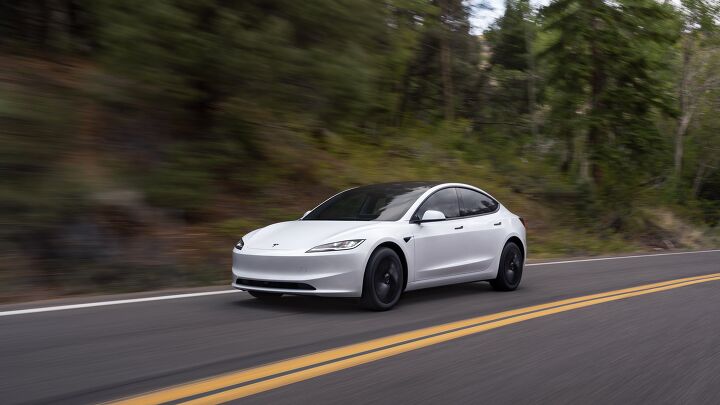
[Image: Tesla]
Become a TTAC insider. Get the latest news, features, TTAC takes, and everything else that gets to the truth about cars first by subscribing to our newsletter.
