
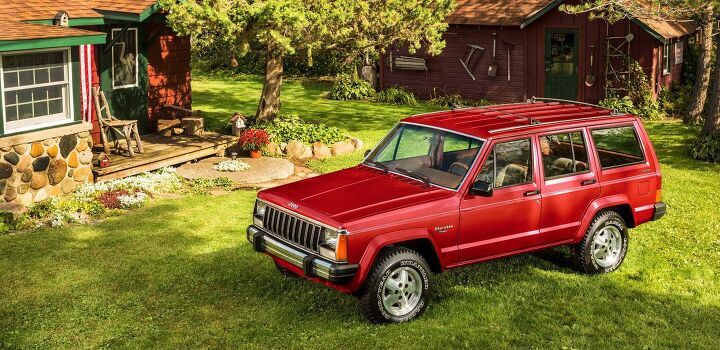
As we learned in our last Wagoneer installment, the SJ weathered the storm of the first (1973) and second (1979) oil shocks. The latter of which forced AMC to reinstall an inline-six and a manual transmission into its luxurious utility wagon barge, to advertise a lower cost of entry and better fuel economy figures. After more than 20 years, AMC was ready to move on from the Wagoneer entirely, and had a plan to do so which it implemented in 1984. Welcome to the new XJ.
In a long project that was in the works since the latter portion of the Seventies, XJ was a radical departure for Jeep. The arrival of Renault ownership in 1979 meant the French firm had input on the XJ’s development, and it became the second such product subsequent to the Renault Alliance that launched in 1983.
Renault pushed for some not-so-American characteristics during XJ development. They wanted it to have an even smaller footprint, be lighter, have more fuel efficiency, and be more car-like with its ergonomics. Renault also applied some direction to AMC designer Dick Teague to come up with a more Euro-inspired design.
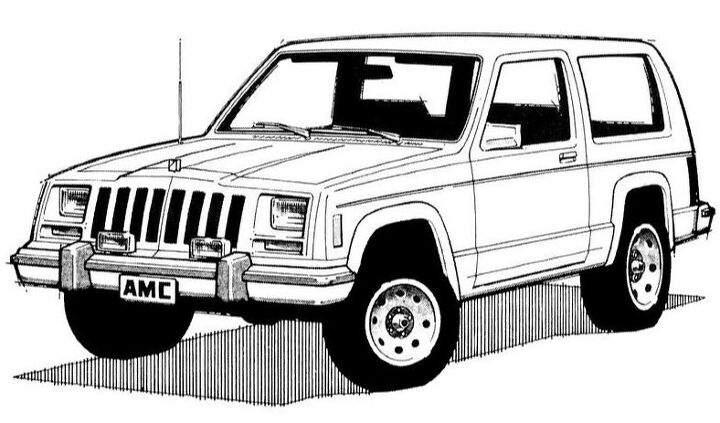
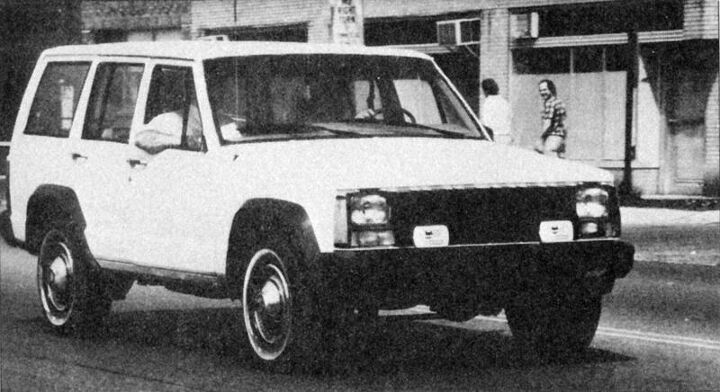
That’s what led to this design sketch from 1982 as featured in an edition of Popular Science at the time. With an angled grille, an AMC plate at the front, and even an AMC hood ornament, perhaps there was question whether the Jeep brand would be used on the XJ. However, shortly thereafter a prototype XJ was seen on the streets sans an AMC badge, and wearing the whitewalls and chrome wheel covers from an SJ Wagoneer.
The XJ was the first all-new model since the SJ in 1963, and Jeep had to make sure they got it right. It was meant to replace the SJ Cherokee, Wagoneer, and Gladiator in one fell swoop. Unlike most utility wagons, the XJ had an integrated body and frame called a unibody. This saved weight, made for better ride and handling, and was a more efficient packaging style than the traditional body-on-frame truck or utility vehicle. And packaging was important, as Jeep intended from the start to create a compact utility vehicle. The project was a very expensive one, as AMC invested $250 million ($875.4M inflation adjusted to 1982) into the XJ’s development.
A compact SUV was on the minds of domestic manufacturers in the early Eighties, and GM beat AMC to the punch when it launched its S-10 Blazer and S-15 Jimmy lines in 1983. However – and it’s a big however – the GM options were not as family-friendly as the XJ from the get-go: They were only available with two doors until the 1991 model year. Ford also debuted the Bronco II in its roll-over friendly two-door guise in 1984, but it never became a four-door model. Ford’s first example of that was the Explorer of 1991.
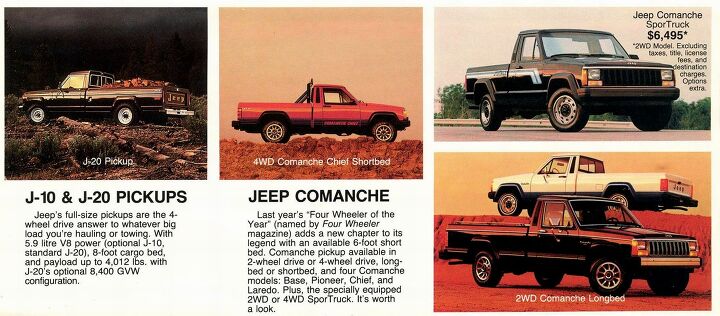
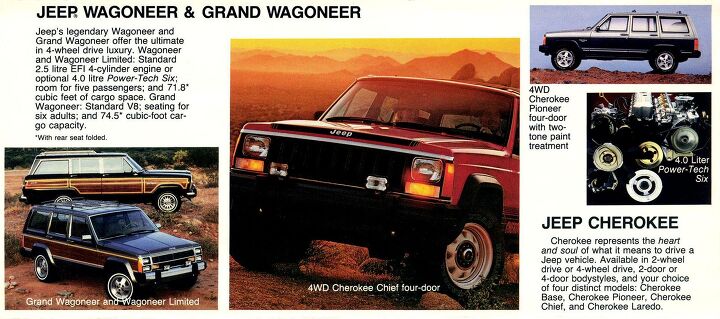
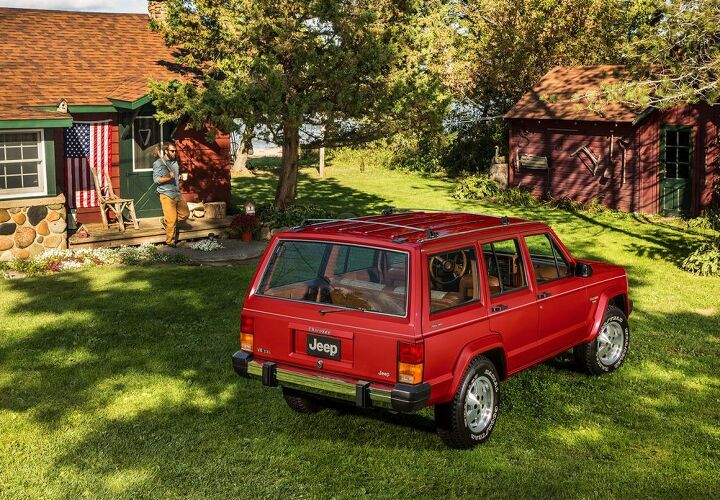
Jeep’s offering was notably different to competition, much like the SJ was at its debut. It focused on practicality and livability. Jeep’s product people saw the SUV craze coming, and the XJ was made with as broad an appeal as possible. Available in two- and four-door versions, the XJ could be trimmed in utilitarian or luxury guises. It was the only unibody utility wagon on offer.
All examples were much smaller than the SJ, and at launch had an overall length of 165.3 inches, 21 inches shorter than the SJ Wagoneer and Cherokee. At 70.5 inches wide, the XJ was about 4 inches narrower than the SJ. Curb weight was around 3,350 pounds, positively a featherweight compared to the 4,510-plus weight of the Wagoneer dependent upon trim.
Powering that lightweight body was a new inline-four engine designed by AMC specifically for use in the XJ. The 2.5-liter was designed with cost savings in mind, and used the existing cylinder bore spacing of AMC engines so new tooling was not required. Performance and durability were the prime considerations during development, as the engine was designed for utility vehicles from the start.
The new 2.5 shared some parts with the long-running inline-six AMC engines, like the water pump, connecting rods, and front housing. The engine used a heavy-duty timing chain design on double rollers with an automatic tensioner. Initial versions used a single-barrel carburetor, but that was swapped for throttle-body injection in 1986.
Parts compatibility was also shared with GM components, in an interesting twist. The 2.5 was a replacement for the GM Iron Duke used in other AMC and Jeep vehicles in the early Eighties. To that end, the new engine did not use the AMC bell housing pattern, but instead the General Motors I4 and small V6 bolt pattern.
Though the Iron Duke was replaced by the 1984 2.5 I-4 engine, AMC continued to source GM’s 2.8-liter V6 (used in lots of GM things) until its own modern inline-six was ready, the 4.0-liter launched in 1987. The 2.8 GM V6 powered the XJ’s more upmarket models until 1987. Other engine options in the XJ included a 2.1-liter Renault diesel, and a 2.5-liter VM Motori diesel.
Despite the GM bones underneath the XJ in some places, it never used a GM transmission. On offer through its run were a four-speed Borg-Warner T4, four- and five-speed manual transmissions from Aisin (a Toyota company), a four-speed Aisin automatic, a five-speed manual from Peugeot, two different three-speed TorqueFlite (A904) automatics from Chrysler, and a New Venture five-speed manual.
All of those were paired to different transfer cases dependent upon year, and in part-time or full-time four-wheel drive configurations. Multiple different front and rear axles were used as well, with various gear ratios. All this meant the XJ was a very flexible vehicle for various use cases.
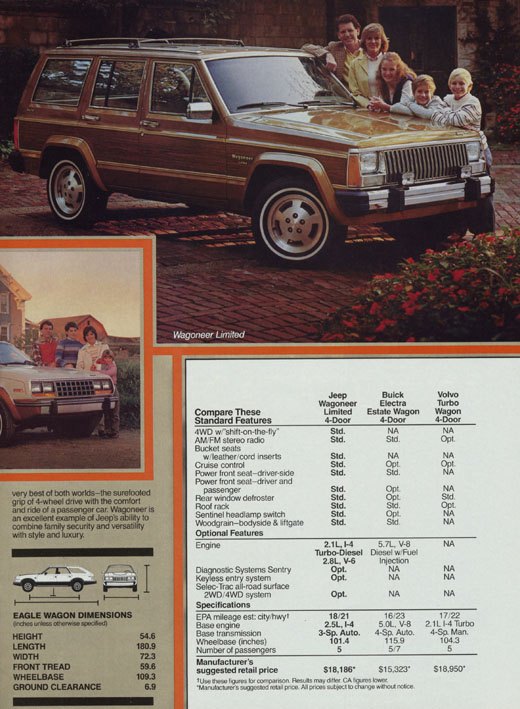
One such use case was the replacement of the SJ Wagoneer with a new XJ-based one. As Jeep saw it, XJ was the future (most everyone agreed there) and the SJ was a relic of the past. Jeep relaunched the Wagoneer in 1984 in a product split that proved very divisive and ultimately was sort of a flop. We’ll cover that in our next installment.
[Images: Jeep, Popular Science]
Become a TTAC insider. Get the latest news, features, TTAC takes, and everything else that gets to the truth about cars first by subscribing to our newsletter.
