
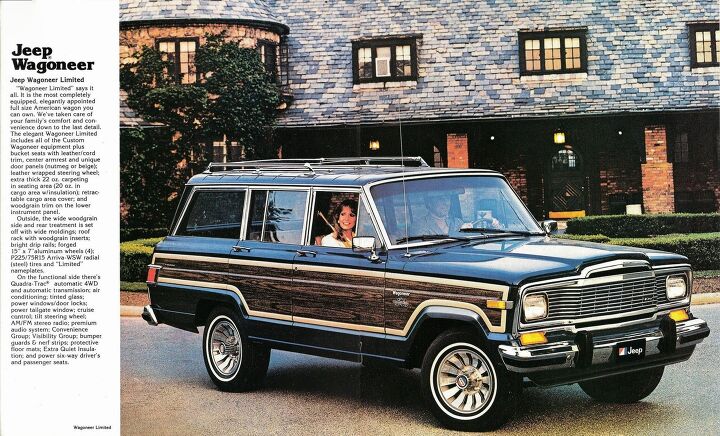

We return to our Wagoneer coverage today at a turning point in the greater automotive market. The introduction of the lower-priced Jeep Cherokee in 1974 allowed Jeep to push the Wagoneer into more luxurious territory, an effort cemented by the arrival of the Limited trim in 1978.5. A few months later all Jeep vehicles were restyled with a new front clip, bringing the lineup to a more cohesive and modern appearance for the ‘79 model year. But world events during 1979 would change the course of automotive history and pull the rug from under the Wagoneer in some ways.

That event was of course the 1979 oil crisis, which occurred due to the Iranian Revolution. Fuel prices shot through the roof, and Americans felt the cost of vehicles with low fuel economy for the second time that decade. The event paved the way for more fuel efficient imports, smaller engines, and future domestic downsizing.
Corporate changes were in the foreground at AMC that year, as the company struggled financially. The oil crisis had put more immediate pressure on AMC to modernize its fleet. The only passenger vehicles AMC had on offer in 1979 were the Spirit, Concord, and the new Eagle in 1980.

AMC needed front-wheel drive and a cash injection, hopefully at the same time. Renault (then state-owned by France) saw an opportunity for immediate product distribution in the US via the AMC dealer network, and wanted to build a Renault vehicle on US soil. A deal was finalized, and Renault purchased a 22 percent stake in AMC in 1979.
The new car project would end up the Renault Alliance of 1983. In the meanwhile, Renault immediately put front-drive cars in AMC showrooms: LeCar in 1979 and the 18i in 1981, while the sporty Fuego arrived the same year as the Alliance. Cars were advertised as “imported by AMC” or “at your AMC dealer.”

Among the corporate changes, product news at AMC in 1980 was the launch of a new type of car that would later become known as the crossover utility vehicle: AMC Eagle. A totally new idea, the compact lineup would include a coupe, hatchback, convertible, sedan, and wagon, the latter of which became the most well-known. Four-wheel drive was standard, a feature unheard of in a passenger car. The Eagle wagon was even advertised alongside Jeep, and wore wood paneling like the Wagoneer.

The only other vehicle of that type on the market was the Audi Quattro; a specialized, limited production coupe that did not arrive in North America until 1983. Cleverly, AMC’s engineers ported the Selec-Trac four-wheel drive system from Jeep directly into the Eagle models. Underneath, all Eagles rode on AMC’s Concord (1978-1983) chassis, the compact “junior car” that was a rework of the Hornet platform (1970-1977).

AMC predicted consumers would appreciate an off-road vehicle with all the comforts of a standard passenger car. Its greater efficiency than truck-based utility vehicles was an added bonus, and it happened to arrive right on time. And because of fuel prices, Wagoneer sought additional efficiency as well.
After a number of years where V8s were the only available power for Wagoneer, the AMC 4.2-liter inline-six was reintroduced in 1980. Also returning to the spec sheet was a four-speed manual transmission. The combination was more fuel efficient, and allowed Jeep to advertise a higher mpg figure and a lower base price. The manual transmission was only available with part-time four-wheel drive, and could not be specified with the full-time four-wheel drive system.

The manual transmission was only available from 1980 to 1982 and only on inline-six models, making the combination relatively rare. In 1983 the automatic transmission was once again the only gearbox on offer, paired to the revised Selec-Trac system which was standard on all trims.
The full-time four-wheel drive system was renamed from Quadra-Trac when the system received a transfer case upgrade. The change swapped out the Borg-Warner transfer case for a New Process NP219 transfer case. New Process (1888-2012) was initially a rawhide company in the 1800s, before becoming a producer of mechanical items circa 1913. Willys-Overland owned the company for some time, then Chrysler purchased it in 1954.

Trims were expanded in 1981, as Jeep recognized customers needed more breadth between the relatively basic Wagoneer Custom and the full-fat Wagoneer Limited. Newly on offer was the Brougham trim, which had thin woodgrain on the middle of the exterior, and included a few features as standard like a power rear tailgate window and a lighting package. Most important to buyers was the upgraded interior trim, a sort of Limited-light. Features like power driver and passenger bucket seats, nice door panels, and a steering wheel wrapped in cow were reserved for the Limited.
With the upgrade to standard Selec-Trac and an automatic transmission in 1983, the Custom model was dropped. Remaining were Brougham and Limited as Jeep had a new product up its sleeve, and it was an important one! The SJ Wagoneer was 21 years old at that time, and Jeep knew it couldn’t run from modernity and regulations forever. It needed to push customers in a new direction.

Said new direction was the all-new XJ Cherokee, the compact unibody Jeep that would become a huge sales success and remain in production through 2001. The innovative XJ had been in development since the latter ’70s, and when it debuted in 1984 was the second product of the Renault-AMC marriage.
The XJ was ready and able to take over for the SJ Wagoneer. It was lighter, more compact, more efficient, safer, and available with American, French, and even Italian engines. It was the first, but not the only, attempt by Jeep to get rid of the SJ and its lore. We’ll talk all things XJ in our next installment.
[Images: Renault, AMC]
Become a TTAC insider. Get the latest news, features, TTAC takes, and everything else that gets to the truth about cars first by subscribing to our newsletter.