
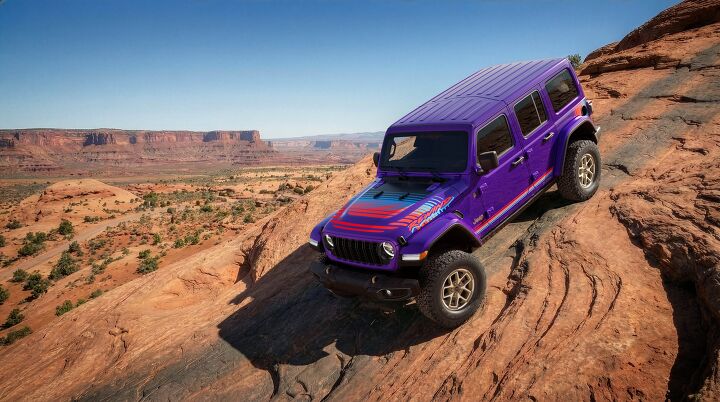
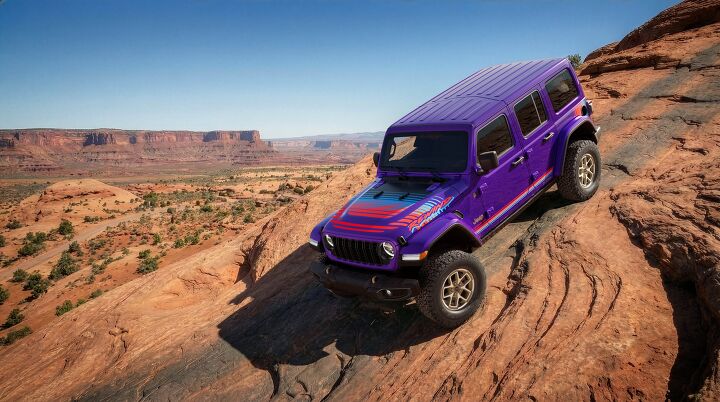
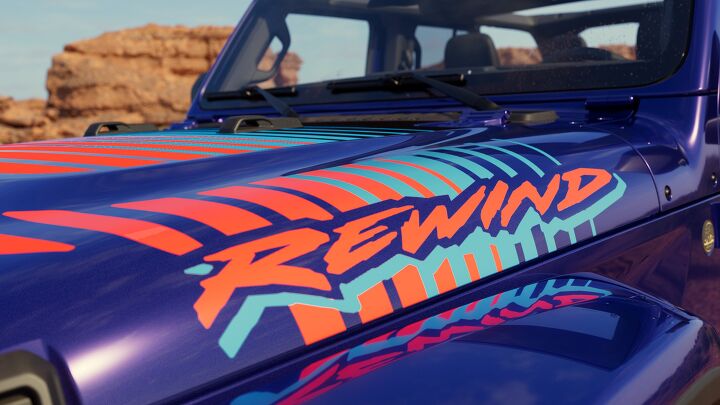
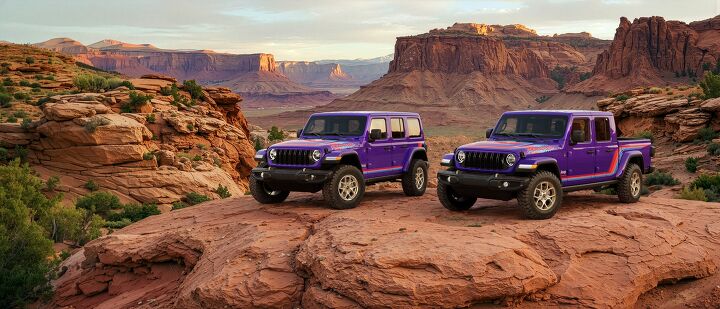
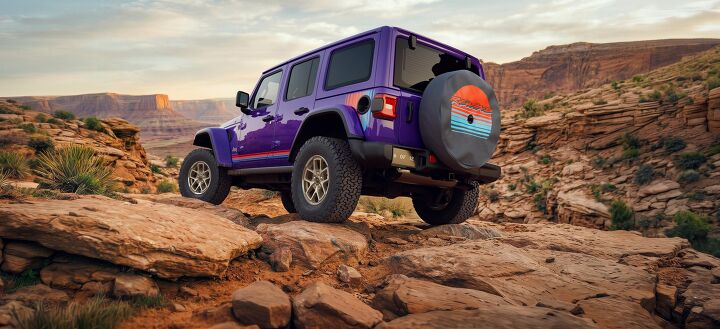
Last year, Jeep promised to deliver twelve “buzz models” designed to hype the brand and help offset some of the recent pricing cuts. These are appearance packages, with the most recent being the 2026 Wrangler and Gladiator Rewind. The duo are clearly inspired by exterior graphics that were semi-common during the late 1980s and early 1990s.
Based upon the Willys model (positioned between the Sport and Rubicon), customers can option either the Wrangler or Gladiator with an extensive graphics package from the “mixtape and roller skate era.” Vehicles also receive off-road tires, steel rock rails, gold-trimmed wheels, gold-trimmed tow hooks, and specific paint combinations designed to fit the period. These include Bright White, Granite Crystal, Anvil, Gloss Black, Hydro Blue, Joose, Earl (only available on Wrangler models) and Reign.
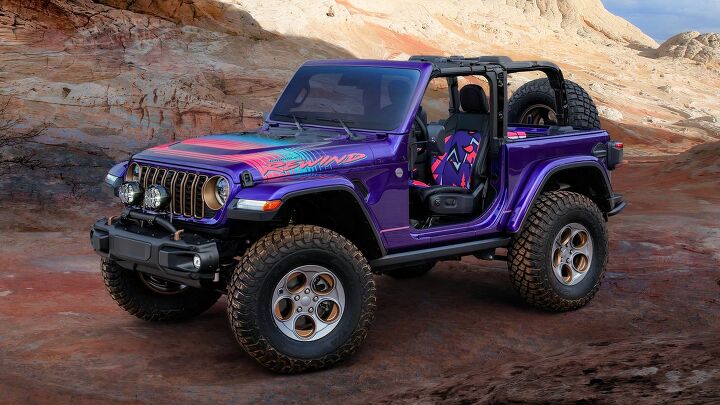
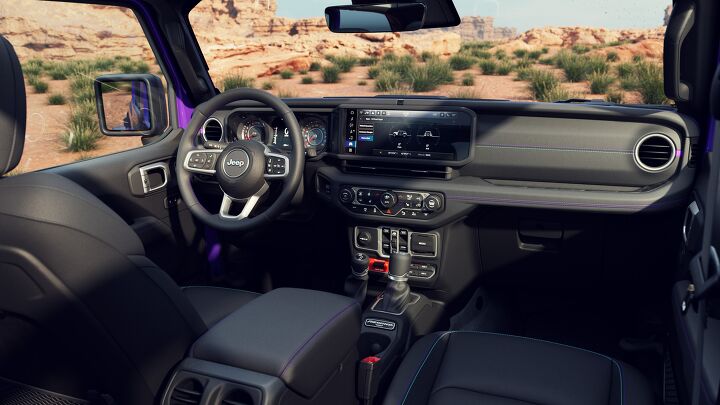
On the inside, Jeep has opted to run with Nappa Leather seats with embossed patterns that are supposed to evoke the “8-bit era.” They’re handsome, and match the unique shift knob cap, but they don’t really hold a candle to the wild seats we saw on the original 2025 Easter Jeep Safari Rewind concept (pictured above).
Everything else, other than the floor mats and limited edition badging or placards, looks to match what’d you find on the standard Willys models. Customers get heated front seats, locking rear differential (with an Off-Road+ driving mode), trailer hitch, programmable auxiliary switches, and adaptive cruise control with frontal collision warning.
“Jeep owners have always had a deep emotional connection to their off-road vehicles, and the Jeep Rewind taps directly into that sense of freedom and first car nostalgia,” Jeep CEO Bob Broderdorf, stated as part of the release. “Easter Jeep Safari has long served as our real-world test bed for future Jeep capability and design, giving us immediate, unfiltered feedback from the most passionate enthusiasts in our community. When we saw how strongly fans responded to the concept vehicle at last year’s Easter Jeep Safari, we knew we had to bring it to life. The Wrangler and Gladiator Rewind special editions are the perfect example of how we’re celebrating our heritage while delivering fresh, unexpected ideas that resonate with our community.”
The biggest start of this year’s Easter Jeep Safari was undoubtedly the Jeep XJ Pioneer, a restomodded Cherokee from the 1984 model year. It was absolutely brimming with throwback charm. But its biggest appeal seems to be the fact that it was kept as original as possible while upgrading its off-road capabilities.
Throwback vehicle designs have been extremely popular since the early 2000s, even though the concept dates back much further. However, the premise of overtly embracing previous design eras went mainstream as a way to cater to the baby boomers. By leaning into retro-futurism, automakers felt they could deliver prettier vehicles that would appeal to the largest and wealthiest demographic.
While the popularity of retro-futurism has persisted, the appeal of older vehicles has changed. Rather than obsessing over the space age or muscle era of automobiles, the industry is shifting more toward what many are now calling “peak car.” This is the period between the late 1980s and early 2010s — which the Jeep Rewind Special Editions attempt to evoke.
However, people are not just waxing nostalgic about classic bodywork anymore. They also miss the simplicity and dependability of models stemming from the previous era. Those early retro-furistic designs, launched to appeal to boomers, were typically much nicer to live with than the 1960s originals cars they were based upon. This is not always the case with newer models thanks to an influx of obnoxious and invasive technology. As a result, today’s vehicles are viewed by many as less enjoyable to own than something simple that was available a couple decades earlier.
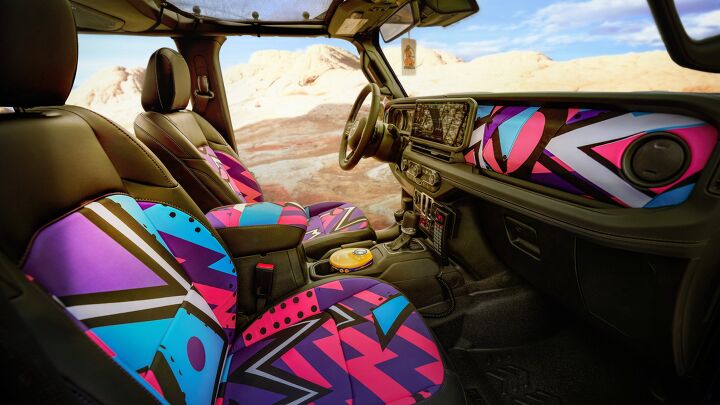
This is something appearance packages cannot accurately address, including Jeep’s Rewind Editions. Still, we would have liked to see them adhere a little more closely to the vehicles we saw during the 2026 Easter Jeep Safari. Obviously, implementing a car phone from thirty years ago would be pointless. But we also don’t appear to be getting that extra-loud upholstery originally featured on the concepts (above).
It’s a decent compromise overall, and one that probably makes sense to broaden its mass appeal. However, it also means that the biggest draw here is the graphics package unless you’re a big fan of the dimpled leather upgrade. If you are, then perhaps the extra $1,900 Jeep is asking for the package seems totally fair. But it admittedly feels a little odd just how much Stellantis toned down the interior details while leaving the exterior as bold as you’re likely to find on today’s market.
[Images: Stellantis]
Become a TTAC insider. Get the latest news, features, TTAC takes, and everything else that gets to the truth about cars first by subscribing to our newsletter.
