
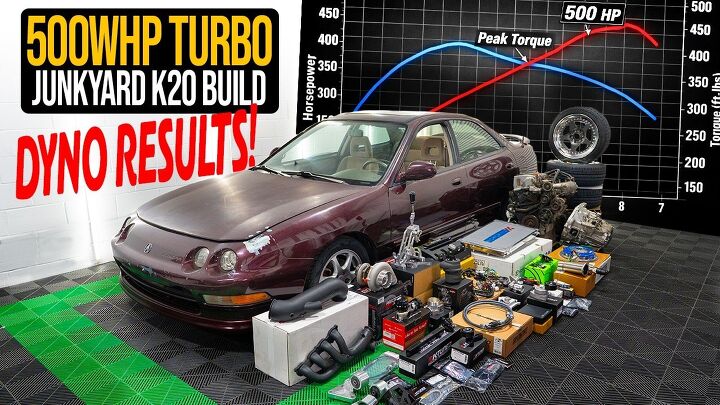
Our K-Tuned supported K20 turbo Integra finally hits the dyno and chases that elusive 500whp mark.
Click the video or transcript below to see more.
Speed Academy is a website and YouTube channel based on making things go fast and enjoying cars. Peter Tarach and Dave Pratte are the forces behind Speed Academy.
The TTAC Creators Series tells stories and amplifies creators from all corners of the car world, including culture, dealerships, collections, modified builds and more.
[Image: Speed Academy/YouTube Thumbnail]
Become a TTAC insider. Get the latest news, features, TTAC takes, and everything else that gets to the truth about cars first by subscribing to our newsletter.
Transcript:
This is our rusty old DB8 Acura Integra GSR sedan—a car we probably should have scrapped. But somehow, its patina convinced us to fully refresh the suspension and brakes. And thanks to K-Tuned, swapping in a K-series engine was basically a bolt-in affair.
Of course, we didn’t go the easy route. Instead of a fresh build, we dropped in a greasy, high-mileage junkyard K20. No rebuild, no forged internals—just questionable life choices and some VTEC. Then we strapped on a Precision 6062 turbo, maxed out the fuel system, and added all the supporting mods.
The goal? 500 wheel horsepower.
But 500 wheel isn’t just a number—it’s right around where stock K-series rods start thinking about exiting the block. So what happens first? Do we hit 500, or do we blow it up trying?
Let’s find out.
With the weather at about 14°C (60°F), we decided to wash the car—even though the paint is in terrible shape. The idea was to try a quick cut and polish to see if we could bring back any life.
The result? The clear coat is gone on the top surfaces, but polishing actually added a bit of shine. It almost looks like forged carbon—completely by accident. It’s not a real fix, but from a distance, it looks slightly better.
We debated repainting a section of the car, but instead of spraying it properly, we tried dabbing paint on with a foam brush. Surprisingly, from about 10–20 feet away, it looks decent—but up close, it’s still patchy and uneven. Definitely a slippery slope if we try to fix every chip.
Next, we prepped for the intercooler. The factory bumper reinforcement had to go to make space, replaced with a custom bar that frees up room for a front-mount setup.
Since fabrication isn’t our strong suit, we headed to a shop where Mike from GT Customs took over. He planned out titanium intercooler piping—partly for performance, mostly because it looks incredible—and handled the exhaust routing as well.
A few moments later (in video time), everything was done: beautiful titanium charge pipes and a custom exhaust with a valve-controlled cutout.
Back at the shop, we wired up the exhaust cutout, installed a blow-off valve, filled the cooling system, and fired the car up.
With the cutout open, the car sounds aggressive and unrestricted. Closed, it’s much quieter. The difference is huge—not just in sound, but also in performance, as the open exhaust reduces backpressure.
Before heading to the dyno, we experimented with wheels. We tried a set inspired by Kanjo racers, but ultimately switched back to the OEM-style wheels for practicality and aesthetics. The car still needs to be lower to really pull off the aggressive look.
At the dyno, we set out to hit our 500 wheel horsepower goal.
On wastegate pressure, the car made strong power but fell just short. Opening the exhaust cutout made a noticeable difference, gaining around 40 wheel horsepower at the same boost level.
With a bit more boost, we finally crossed the goal:
503 wheel horsepower.
Pushing further, we reached:
530 wheel horsepower at 18.5 psi.
At that point, the turbo was near its limit, and there wasn’t much benefit in pushing harder. Still, 530 wheel in a ~2700 lb car is seriously quick.
In the end, the engine survived—and exceeded expectations.
We didn’t blow it up, we hit our goal, and now the obvious next question is:
How far can a stock K20 really go?
That’s a test for another day.
