
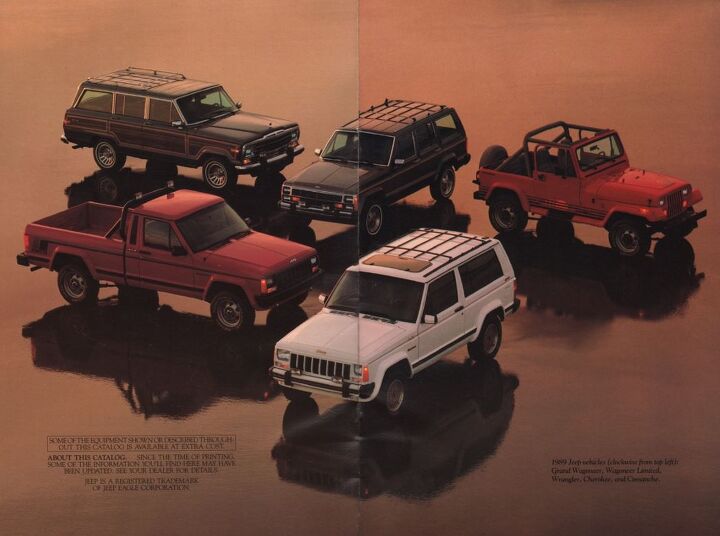

Jeep had its only all-new product debut since the Sixties when it introduced the compact XJ Cherokee in 1984. Designed with packaging and fuel efficiency in mind, the unibody Cherokee was a departure from the way SUVs were traditionally designed. Also launched with the new Cherokee range was an all-new Wagoneer.

The SJ Wagoneer, though beloved by a certain customer base, was also ancient and living on borrowed time. On the same platform since its 1963 introduction, competing models from other makes had been redesigned several times by the Eighties. With those factors firmly in mind, Jeep introduced the new XJ Wagoneer in 1984 and planned to kill the SJ Wagoneer shortly thereafter.
XJ Wagoneers (in Limited guise) wore the same style exterior wood trim of the full-size Wagoneer, and piled on additional standard features. The trims of the XJ Wagoneer mirrored the SJ too, as it was available in base version Wagoneer, or fully-loaded Wagoneer Limited. Granting the Limited name to the XJ Wagoneer showed Jeep’s future intentions with the SJ. But it also created the SJ Wagoneer trim everyone thinks of when considering the SJ: Grand Wagoneer.

At the debut of the XJ Wagoneer, the SJ Wagoneer Brougham (then the base model) trim was dropped, and the Wagoneer Limited remained as the sole offering. As the Limited name was donated to the XJ, the SJ version was simply rebranded as Grand Wagoneer. There were no other changes made to create the Grand Wagoneer except the name, though some incorrectly believe it was an upgrade and a new luxury Wagoneer version. It’s not surprising Grand Wagoneer was a change in name only, as the SJ platform was headed for the bin as far as Jeep was concerned.

The XJ Wagoneer was distinguished from the lesser Cherokee versions via its aforementioned wood, upgraded alloy wheels (often with whitewall tires), and a grille design that wore fine vertical slats. Mirrors, door handles, wheels, and bumpers were finished in chrome, which was not available on Cherokee models. Wagoneers also wore their front Jeep logo off to the side in a smaller font than Cherokee, to emphasize its upmarket Wagoneer-ness.

The Wagoneer Limited’s interior with its standard features and trim entirely different to the Cherokee was likely the reason customers sprung for the most expensive XJ. Inside there were trim-specific cloth-leather seats with vertical ribbed detailing, additional bolstering, nice stitching, and even power adjustment. Limited script was embroidered into the seats both front and rear. There are lots of photos of a pristine Wagoneer Limited here.
Most equipment was standard, with features like air conditioning, rear wiper, tilt wheel, and power disc brakes all around. Door panels were thickly padded and had Wagoneer emblems, with wood trim on both the upper and lower sections of the door. Door lock, window, and seat adjustment switches received their own wood trim. There was additional wood across the dashboard.

The base Wagoneer did not wear exterior or interior wood trim, and was much less popular than the Wagoneer Limited. It was not advertised in brochures, and it takes some searching to find photos of the base Wagoneer. With a standard Cherokee interior and Cherokee wheels, it was no wonder why the base Wagoneer was a slow seller.
Original XJ Wagoneer looks lasted only for the ‘84 and ‘85 model years, and were revised in 1986 to give greater differentiation to the premium XJ. Single sealed beams shared with the Cherokee were replaced with vertically stacked versions, the four-headlight look exclusive to Wagoneer. The grille was also revised to feature fine horizontal eggcrate instead of vertical slats, and the indicator lamps were inset in the grille.

There were some simple updates to the rear of the Wagoneer in 1986, as it received model-specific brake lamps with full red lenses. The former Cherokee lamps it wore were red at the top and used an amber indicator lens. The following year in 1987 the Wagoneer Limited became the only XJ Wagoneer, as the slow-selling base model was eliminated.

It’s interesting to see the competition Jeep specifically highlighted for the Wagoneer Limited. As the luxury SUV segment was still in its infancy, Jeep compared it to premium wagons instead and accidentally predicted the future consumer shift. Specifically called out were the full-size Buick Electra Estate Wagon, and the Volvo 740 Turbo wagon.
The Wagoneer Limited had more features than the Buick or the Volvo, and offered keyless entry and four-wheel drive that was unavailable on either of those. Wagoneer limited asked $18,186 ($56,921 adj.) in 1985, compared to the $15,323 ($47,960 adj.) of Electra, and $18,950 ($59,313 adj.) for the Volvo. Accompanying the same page as the Grand Wagoneer in the brochure, the Wagoneer Limited was for the upscale family. The Grand Wagoneer was for Jim McBride, Texas oil man, and his third wife Elaine.

But the XJ Wagoneer didn’t really pan out. Customers weren’t loyal to it like they were with the SJ, even though it was better and more modern in most every way. It lacked the established prestige of the larger SJ Wagoneer. Sales were 24,731 the first model year, then dropped off each year thereafter.
By 1986 just 12,672 XJ Wagoneers were sold. That figure dropped to 6,537 in 1989, which proved to be the model’s final year. It was cancelled quietly in 1990 as the Grand Wagoneer became the only Wagoneer in the Jeep lineup. But the XJ wouldn’t be Jeep’s only Wagoneer tangent! In our next installment we’ll swap back to the Grand Wagoneer which had some Eighties developments as it remained in production to the chagrin of AMC.
Become a TTAC insider. Get the latest news, features, TTAC takes, and everything else that gets to the truth about cars first by subscribing to our newsletter.
